• The Final Enactment

    “So, what are you up to this winter vacation?” asked his father.
    “No plans as such, just hanging out with friends”, replied Anwar.
    “Don’t waste your holidays. Do something fruitful. Look for internships”, said his father.

    Anwar Saeed, a 21-year-old history graduate from DU, was a flamboyant but reluctant man. He quietly goes about life as if he is carrying a hidden world inside him. He is always surrounded by rumors. In fact, he was controversy’s favorite child. It was always some girl or other. After all, he was the handsome hunk of college.
    Very few knew his actual identity. The real Anwar lay buried in his childhood. Nobody knew that today’s heartthrob had a gruesome childhood. His true-self lay hidden in this flamboyant character. He was bullied in school.
    “Are you sure, you aren’t Anisha?” asked his friends gleefully.
    They called him Anisha Parekh, sister of Asha Parekh. People ridiculed him by drawing a comparison with the famous actress.

    It was the 1970s, and Asha Parekh was dominating the hearts of young boys. Anwar was one of them. While every girl wanted to be a sophisticated actress like the famous Asha Parekh, the boys longed to romance such a girl. But Anwar’s longing was different than others. Indeed he carried a different world in him. It wasn’t the regular longing of a teenage boy – the longing of romance or stardom.

    Anwar marveled at the beauty of the actress. Her winged eyeliner, classy hairstyle, the shimmering saris that she wore and her flamboyant attitude, eluded him. He secretly imitated her. Every day, after returning from school he put on his mother’s lipstick and draped her chiffon saris. One day, Anwar’s mother Jasmine came home early from work. She managed a catering service. She was taken back when she found Anwar dancing to the tunes of “Parde Mein Rehne Do”.

    “What are you doing with my lipstick and sari?” asked a startled Jasmine.
    “Nothing. Just practicing a dance number for our school play”, said Anwar.
    “But why are you playing the part of the girl? Didn’t they find any girl for that?” inquired his mother.
    “It’s a girls v/s boys competition, Ammi. Boys and girls are performing separately”, said Anwar.
    “Okay. So, you are the heroine of your play. Good. But don’t waste my lipstick and no stains on the sari”, cautioned Jasmine and left.
    “Thank God that she didn’t ask the name of the play”, sighed Anwar.
    All seemed to be alright for the time being but Anwar feared his father, Aftab.

    Aftab Saeed was an astute traditional Muslim. He wouldn’t take this lightly. Her son performing at a play was blasphemous in his eyes. Anwar remembered the first time he conveyed his feelings for films and theatre to his father. He was a child of eight then. Aftab severely rebuked him.

    “My son would not waste his days gaping on films and film stars”, said Aftab. “I should never find you anywhere close to this hullabaloo. Stay away from these Natak Company people” he added. As a child, Anwar was forbidden to watch movies and theatre performances. “Abbu even detested T.V. commercials. It is always News and Sports for us”, he complained to his friends. But Anwar made peace with it as he got ample fodder from his frequent visits to a friend’s home.
    So, that day when his father caught him coming out of the theatre hall, he gave him a violent beating. From then onwards, he kept his interests under wraps and secretly pursued them.

    “God knows what will happen this time! I hope Ammi didn’t tell Abbu about today’s incident”, thought Anwar. The day went quietly. Jasmine seems to have forgotten ‘the sari incident’. All was well at the dinner table and the family enjoyed their Iftar feast.
    “What a relief!” thought Anwar. But that was not to be. A few days later, he found his father fuming in rage and beating him.
    “What happened? Why are you beating me up Abbu?” asked, a startled Anwar.
    “What happened? You have the audacity to ask this. How many times have I told you to stay away from those Natak Company people” fumed Aftab.
    Apparently, Jasmine had ratted out “the sari incident” by mistake and as usual, Aftab was fuming in rage at his blasphemous son.
    “But Abu I was just taking part in the school function”, Anwar protested. “It’s our final year.”
    “Whatever be it, I don’t want to see you anywhere near that stage. Stay away from that vicious circle”, said his father.
    “But….” Anwar protested meekly.
    “No Buts. That’s my order. End of discussion.”
    And with it ended Anwar’s dream.
    Yet he couldn’t refrain from his natural inkling and enrolled in a theatre class. It opened up a new world to him. A world which he carries with him but can’t express. It was a world within a world. A place where he can be himself. No one knew about his secret pursuits except her mother, who continued to nurture it, away from his father’s eyes.
    Gradually, that passion helped in recognizing his own identity. His inborn nature which he was unable to express. The reluctance in him was a product of that.

    When Anwar finished school, his father enrolled him in a prestigious college in the Delhi University. It was his father’s dream, a dream that Aftab couldn’t fulfill for himself. He wanted his son to live that dream. He wanted Anwar to become a teacher – a professor. Thus, Anwar went on to study history in DU rather than going for that acting course in Pune.

    His passions seemed to follow him wherever he went. In college, they found refuge in the Drama Club. Owing to his acting skills, Anwar became popular in no time. Whatever, be the occasion, Anwar was indispensable in every college performance. Everyone marveled at his acting skills. “How easily he enacted the ways of women”, said the audience. Seldom did they know that he wasn’t acting. It was his truest form. He was living his true self – a self he was himself unaware of.

    As time passed by he became aware of his inner self. His childhood inkling and feminine ways which were so vehemently ridiculed is making perfect sense now. It was actually a boon in disguise of a bane – a way of living, only understood by a few. He was special.
    He had the gift of both the worlds. His homosexuality was an asset. A blessing that made him understand both the sexes – men and women alike.

    Although he was aware of his own sexuality yet he was quite afraid to disclose this to the whole world. More than the world, he was afraid of his family, especially his father Aftab. So he concealed the fact and went on his usual ways.
    But fate would not have it.

    One day, he was on his usual pursuits of trying out his mother’s cosmetics and feeling himself when the calamity occurred.
    His mother walked into the room just as he was about to apply her new lipstick. She was startled. He was startled. “What are you doing with my lipstick? It’s new….. I haven’t used it so far. Couldn’t you have waited?” He smiled and handed it back to her. “I forgot to tell you…I am playing Drapaudi in our college production…rehearsals start this evening”, saying this he quickly went back to his room.

    He couldn’t believe his ears. Did he hear it right? It was indeed his mother speaking.
    “Does this mean that she knows about my sexuality?” wondered Anwar.
    “Ah! Mothers! One can never keep a secret from them”, chuckled Anwar.
    Suddenly, it struck him that this means she is okay with it and his father still doesn’t know a thing about it.
    “My mother is a fine actress herself. She knew everything all this while and yet didn’t let anyone get a whiff of it.”
    As soon as the thought came to him, he ran to hug her.
    “You are a darling! My guardian angel. My savior”, said Anwar hugging his mother.
    “Enough of buttering. This doesn’t mean I approve of your ways but I understand it’s your normal self. It makes you, YOU”, said Jasmine. “Now, don’t tell your Abbu. I’ll find a way to deal with this mess. Till then be careful and vigilant.”

    That night he went to bed feeling happy. His fears have given away to courage. Suddenly, he was feeling an urge to conquer the world. An indomitable spirit had gripped him making him courageous.
    “Acceptance gives us the courage necessary to fight with this world. It sets us free.” Anwar wrote in his diary. Her mother’s acceptance has set him free. It has erased the heaviness of his heart.

    That night Anwar wrote the screenplay of his new novel. It was a story of a reluctant young lad caught in the time warp. A story of failures, fears and redeeming one’s self from his own self. But above all, it was a story of courage. A story of chance.

    The following day, he showed his new story to his friends at the Drama Club. He was quite sure of its success and wanted to make a film out of it. But alas! His friends found it absurd and deemed it unsuitable for performance.

    “This is a terrible story. It would destroy our goodwill. The audience won’t accept it. Moreover, it will ruin the fabric of our society”, they said.
    Few days later, Anwar’s mother came running to him shouting “What have you done! What have you done!”
    “What is it, Ammi?”
    “Who told you to write that story?”
    “What story?” asked, a startled Anwar.
    “I read ‘The Third Act’. I told you not to tell your father and here you are telling it to the whole world!”
    “Don’t worry, Ammi. Nobody believes it. And besides, The Drama Club have already dismissed it.”
    “Are you mad? You even went ahead with its production!”
    “Promise me you won’t make it public until we are dead,” said Jasmine

    This hit him hard. His mother has accepted him with a rider. It wasn’t understanding or unconditional love. It was a trap to hide his identity. As if it was a ghost. He understood the meaning of this and left home without a word.
    12 years went by, Anwar was an aged man now who was still struggling with “The Third Act”. No one has accepted it. “Acceptance is hard to achieve, just like Freedom. Perhaps even harder than Freedom”, thought Anwar.

    A couple of years later “The Third Act” hit the silver screen. It became a cult classic in no time.
    Anwar Saeed finally lived his true self.
    It was his last act – his FINAL ENACTMENT

  • Supermoons, wonders of  our routine world.

    Supermoons, that unlikely event in our routine life which kicks out a storm whenever it appears. All of us are quite excited about it. This is an important time for astronomers, stargazers, and astrophotographers. It is our refuge from the mundane world giving us an opportunity to look up into the sky.

    DSCN4920
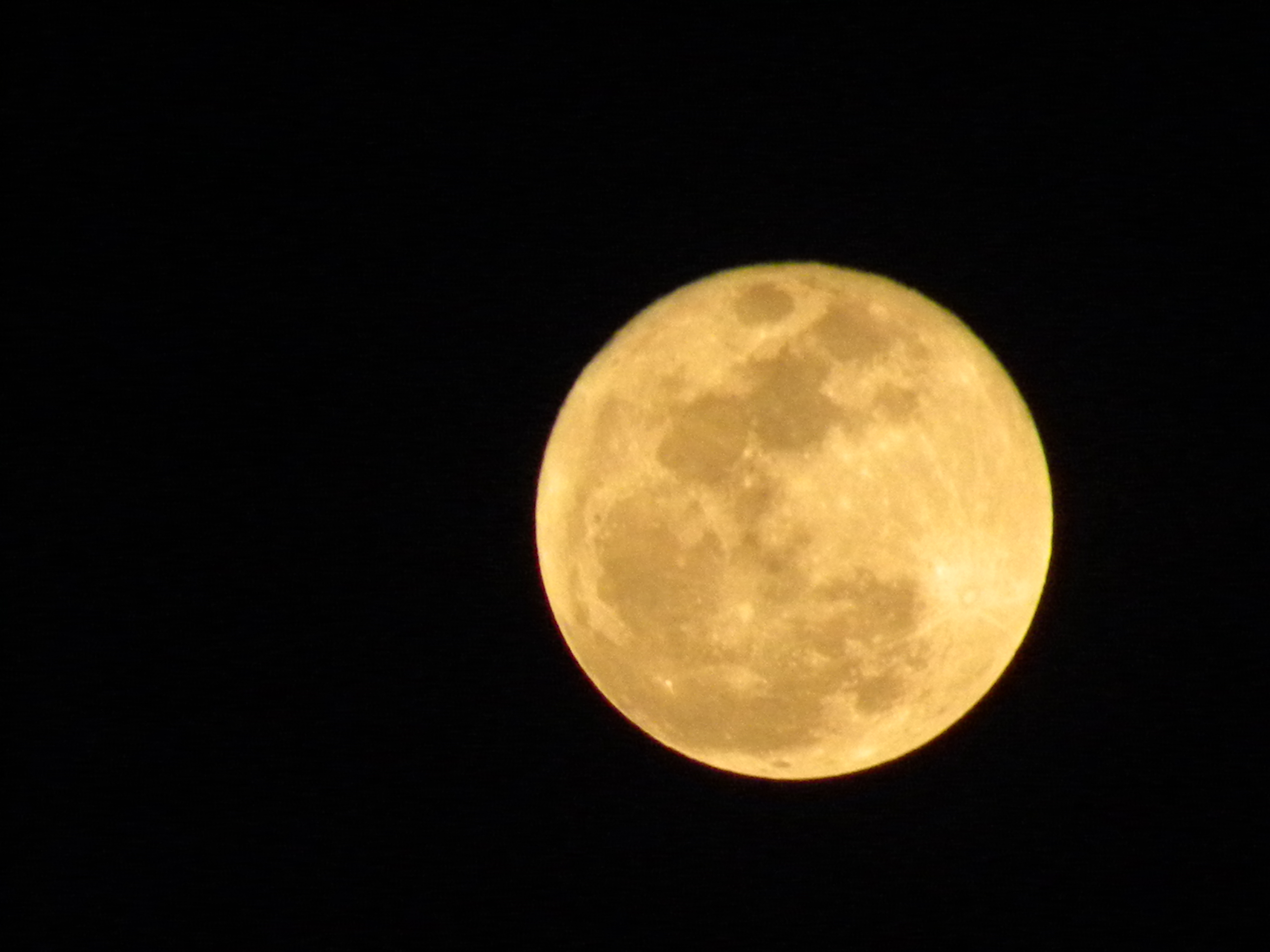
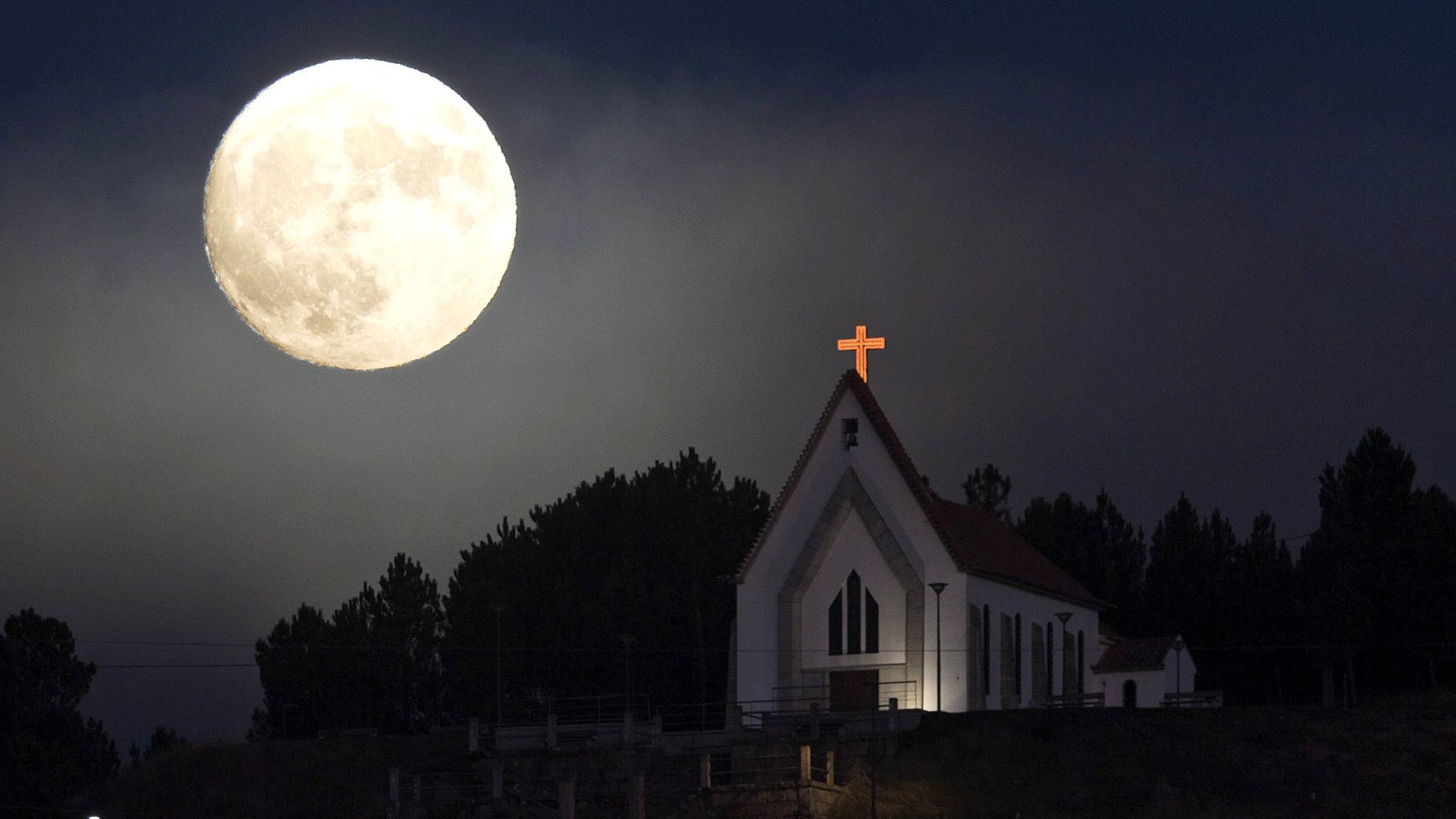
    The Supermoon rising on January 1, 2018
    DSCN5018
    The glowing supermoon on 2nd January 2018

    Now, the question is what exactly is a supermoon?

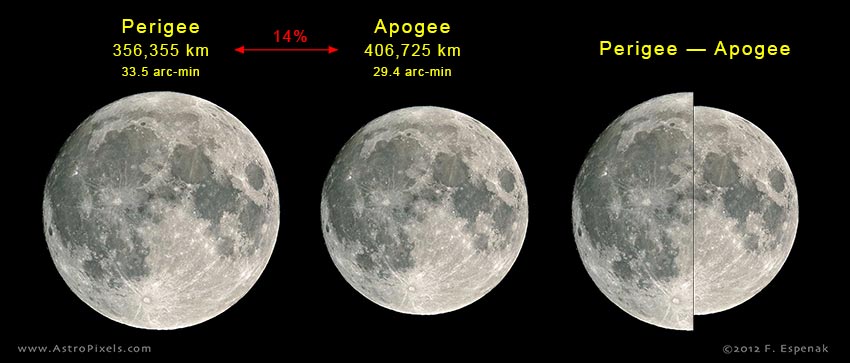
    26.10.15A supermoon occurs when a full moon comes closest to the earth and appears 14% larger than what we see in ordinary. It’s called the Perigee or Perigean moon as the closest position to earth is termed as the perigee position. On the other hand, the time when the moon is farthest from the earth it’s termed as the apogee position and the moon is called the apogee moon. All of this is due to the elliptical orbit of the moon. But all such perigee positions doesn’t give rise to a supermoon. Thus supermoons are a rare event and occur once in a while in a year when extreme perigee coincides with a full moon.

    figmoon2
    Source: Southern American Delights
    supermoon 27 sept'15
    The Supermoon of 27th September, 2015
    Supermoon cloudy, 29 aug'15
    The Supermoon of 29th August, 2015
    supermoon jan12'17
    The Supermoon of 12th January 2016

    So, at certain times of the year, you get to see a supermoon when the moon shines brighter than usual and appears 14% larger than its perceived size. 2 things are important here

    • The sun’s and the earth’s gravitational pull which changes the shape of the moon’s orbit making an extreme perigee.
    • A full moon occurring at the time of an extreme perigee. 

    PerigeeApogeeCompare-1v

    The name supermoon which we hear today was actually given by Astrologer Richard Nolle  (in 1979) due to its unusually bigger size. Here’s a tentative schedule of the supermoon as predicted by Nolle.

    According to this list, there are 2 supermoons occurring in the year 2018, on 1st and 31st January. So, the year starts with a supermoon month and also a lunar and blue moon in January. The eclipse is scheduled in the 2nd full moon of the month, on 31st January. 2 full moons in one month makes it a blue moon year with the 2nd full moon being the Blue Moon. So, the year begins with a bang. 

    Click on the link to see the full list.

     http://www.astropro.com/features/tables/cen21ce/suprmoon.html

    How supermoons occur?

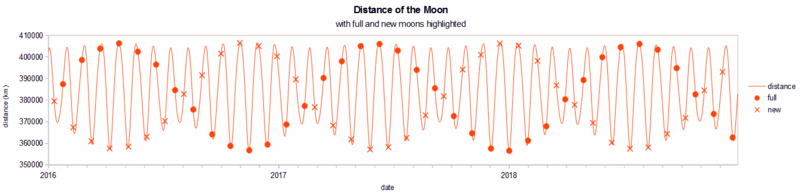
    Similar to the eclipses, supermoons occur in pairs, that is, there is a propensity of 2 supermoons occurring consecutively in the upcoming months. So a supermoon in December is followed by one in January. As it happened this year. Astronomers use a graph that predicts the occurrence of supermoons based on tehir relative distance from the earth. The supermoons are marked dots appearing at the bottom of the graph.

    Moon_distance_with_full_&_new
    source: Wikipedia

    The equation used for this graphical analysis is as follows,

    Relative Distance = (Da – Dfm)/(Da – Dp)

    Now, this relative distance is the distance of the full moon (Dfm) from apogee (Da) and perigee (Dp) position. When this relative distance is 1, it’s in the perigee position and when it is 0, it’s in the apogee position. A relative distance of 0.9 marks a supermoon position. This explains the unusually bigger structure. 

    The same equation provides insight into the relative brightness of the supermoon. In this case, the comparison is between the apogee and perigee position. “A supermoon is typically 1.3 times (or 30%) brighter than a Full Moon at apogee, and 1.15 times (or 15%) brighter than a Full Moon at the Moon’s mean distance.” So this explains the bright supermoons that you see.

    When is the ideal time to view a supermoon?

    images (4)
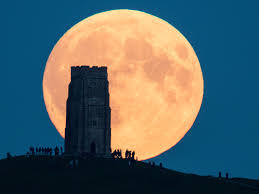
    A Supermoon rising at the horizon. Image Source: The Business Insider

    A supermoon is a perigee supermoon which is brighter and bigger than the usual moon seen on regular days. However, the larger size can’t be perceived by a layman that easily. A trained professional like astronomers might be able to recognize it instantly but others can’t. One sure way to catch the change is to view when it rises just after the sunset. A rising supermoon at the horizon is the best way to view a supermoon. Another way, to get an idea about the size is by comparing it beside some tall high rising buildings or monuments.

    la-sci-sn-2016-supermoon-20161111
    The Supermoon of 14th November 2016. Image: Los Angeles Times
    24291722_150983658872652_8071460625129221196_o
    The Supermoon of 3rd December, 2017
    download
    Source: NASA

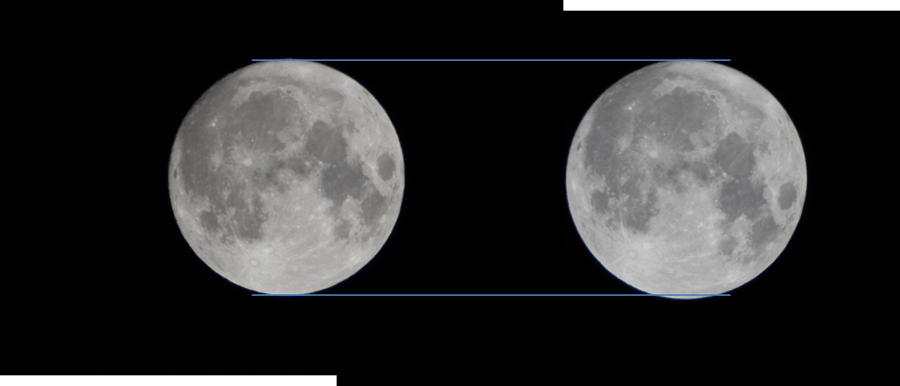
    The above picture shows the November 13th supermoon of 2016. See, that the picture on the right seems bigger than that on the left. This is due to the time of the picture taken. The right-hand side picture was taken when the moon was on the horizon and the left-hand side picture was taken when the moon was high up in the sky!

    DSCN4936
    Signing off with the glowing supermoon of today! (01.01.2018)

    Now, that you are equipped with information, go get a look at the supermoon tonight. Catch them on the horizon!  For more information on the trajectory of moon this year, visit this page https://moon.nasa.gov/resources/154/


  • The Shillong Autumn Cherry Blossom Festival – A Fortune Teller’s Land


    Last month I was at the foothills of the East Khasi hills. A sudden chance trip to “the abode of clouds”- Meghalaya came my way. Trapped in the busy schedule of work and entrance exams, I hadn’t planned a vacation for a long time. Then, suddenly I had a chance acquaintance with the Indian Cherry Blossom Festival. Before this, I had little idea that this Japanese festival happened in India. Apparently, it did happen and that too in autumn.

    23551231_308269912987347_344578942370898983_o
    Jiva Veg, Ideal stopover at the NH6 highway if you are famished on the way from Guwahati-Shillong
    beautiful-floral-decor
    Jiva Veg tucked in between hills. Picture from Tripadvisor

    [Note: This was my first stop way to Shillong from Guwahati. The restaurant has a handicraft store downstairs. A hearty breakfast at Jiva Veg empowers you for the journey. I shared a masala dosa and a plate of aloo parantha with my mother here.]

    DSCN4059
    The beginning of the journey at Wards Lake

    DSCN4070

    While the world prepares for departure Shillong prepares to welcome the blossoming of life. So, I couldn’t afford to miss this opportunity and immediately headed to the land of clouds. Much like any other natural event, the blooming was unpredictable.

    DSCN4089
    The Autumn Leaves
    DSCN4528
    And the blossoming spring

    By the time, I landed in Shillong on 8th November, the honking, and bustling Himalayan city had prepared itself for the festival – a 3-day long affair celebrating life by the soothing cherry trees. While the blossoming trees were hardly seen, the festival was bustling with life – traditional music, rock concerts, food and wine festival, handicrafts –all were there. Even, the Meghalaya Chief Minister, Purna Sangma gave a surprise performance, a scene which I hadn’t encountered in any other Indian city.

    This slideshow requires JavaScript.

    official festival 1
    People enjoying at the festival.   Picture: The official page of India International Cherry Blossom Festival
    ooficial festival 2
    People at the festival. Image from the  official event page

    The Rock Band Performance at the Festival

    The Fountain of Love and the children surrounding it, at the Lady Hydari Park,  Shillong

    DSCN4119
    The Cherry Blossom Festival Themed Menu at the Bamboo Hut Cafe in Wards Lake. A good place for a tasty meal
    23406124_306494473164891_3848365729019792936_o
    Chilli Pork From the Bamboo Hut Cafe. An absolute delicious dish
    23415185_306752889805716_2209417733597245544_o
    Schewan Chicken Fried Rice and Chilli Garlic Fish at the Lake View Inn. The perfect place to stay in Shillong.
    23516357_1588656004514311_1565609048_o
    A View of the Wards Lake from the Lake View Inn
    DSCN4458
    Wards lake lit up for the night walk


    This slideshow requires JavaScript.

    People enjoying local cuisines at the Food and Wine Festival.

    23826190_356042241489565_5302630497616611187_o
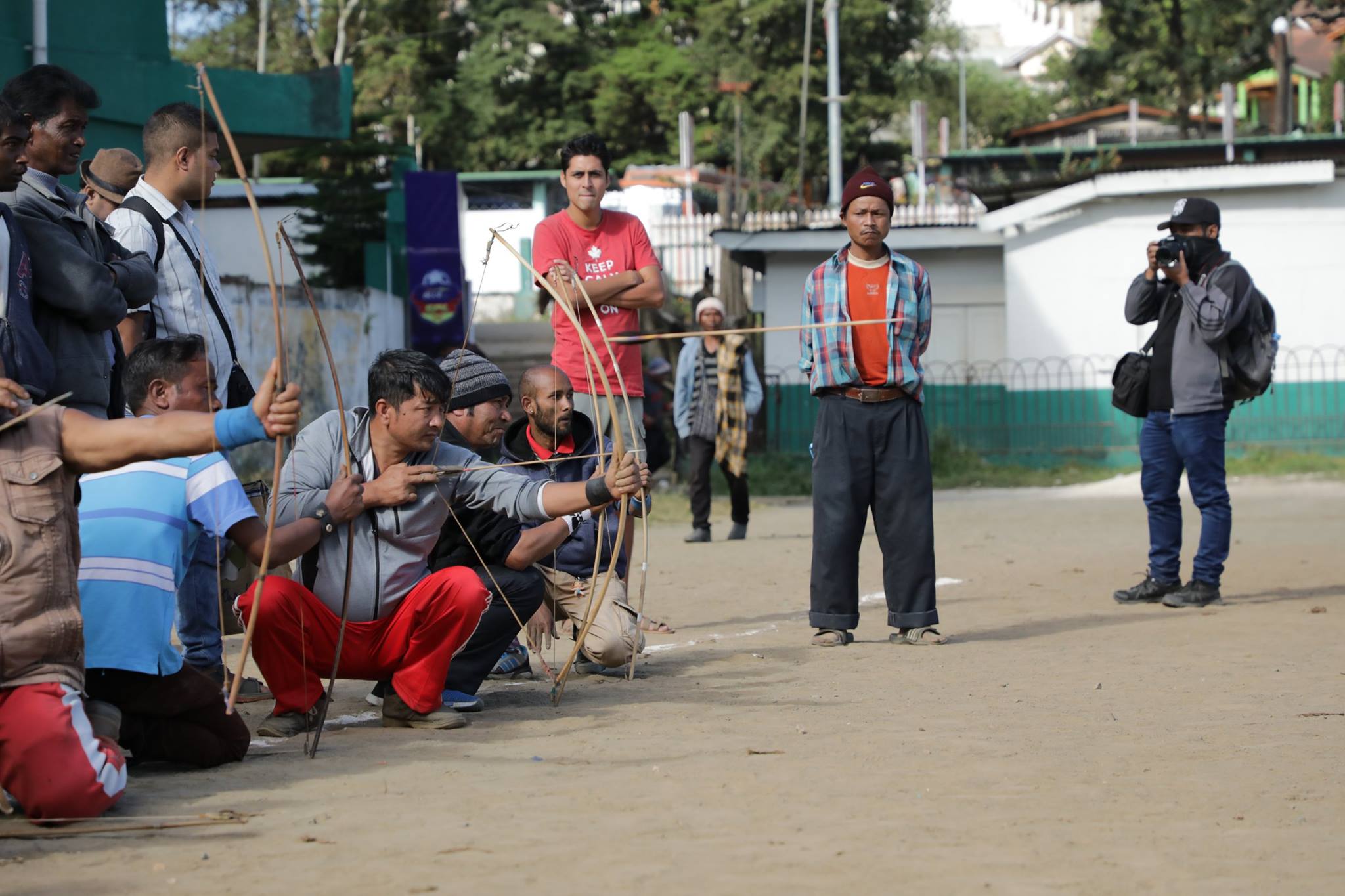
    The Archery Competiton

    23826138_356042221489567_973619800908851894_o

    23783700_356045341489255_8813790378920611495_o
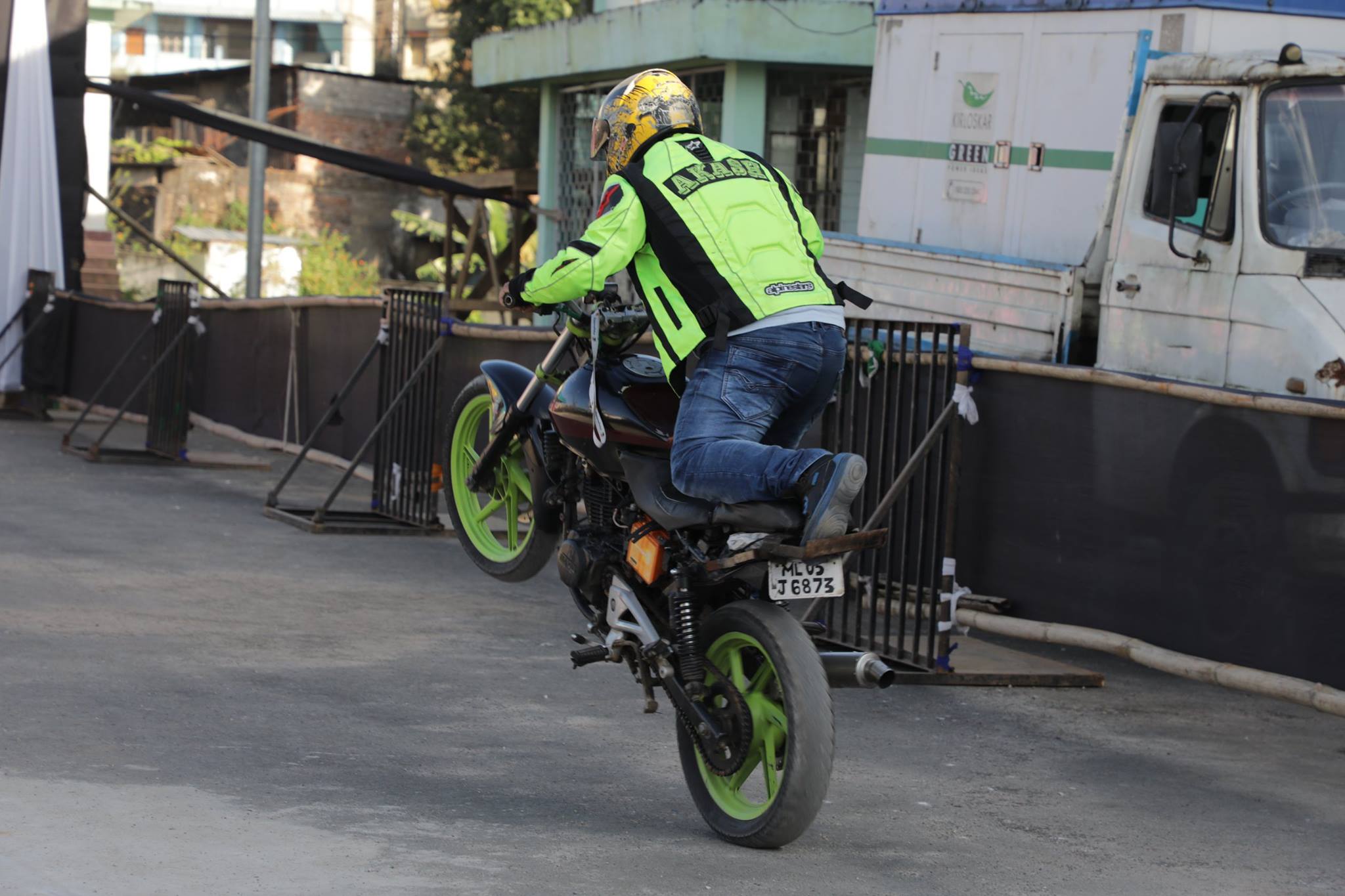
    The Bike Stunt Rally
    23847215_356041064823016_7597902139974972050_o
    A marathon runner at the Cherry Blossom Run.  Image Credits: The official event page
    23783603_356035738156882_7590651819952098327_o
    The Fashion Show.  Image from the official event page
    23737818_356034178157038_962859404453660013_o
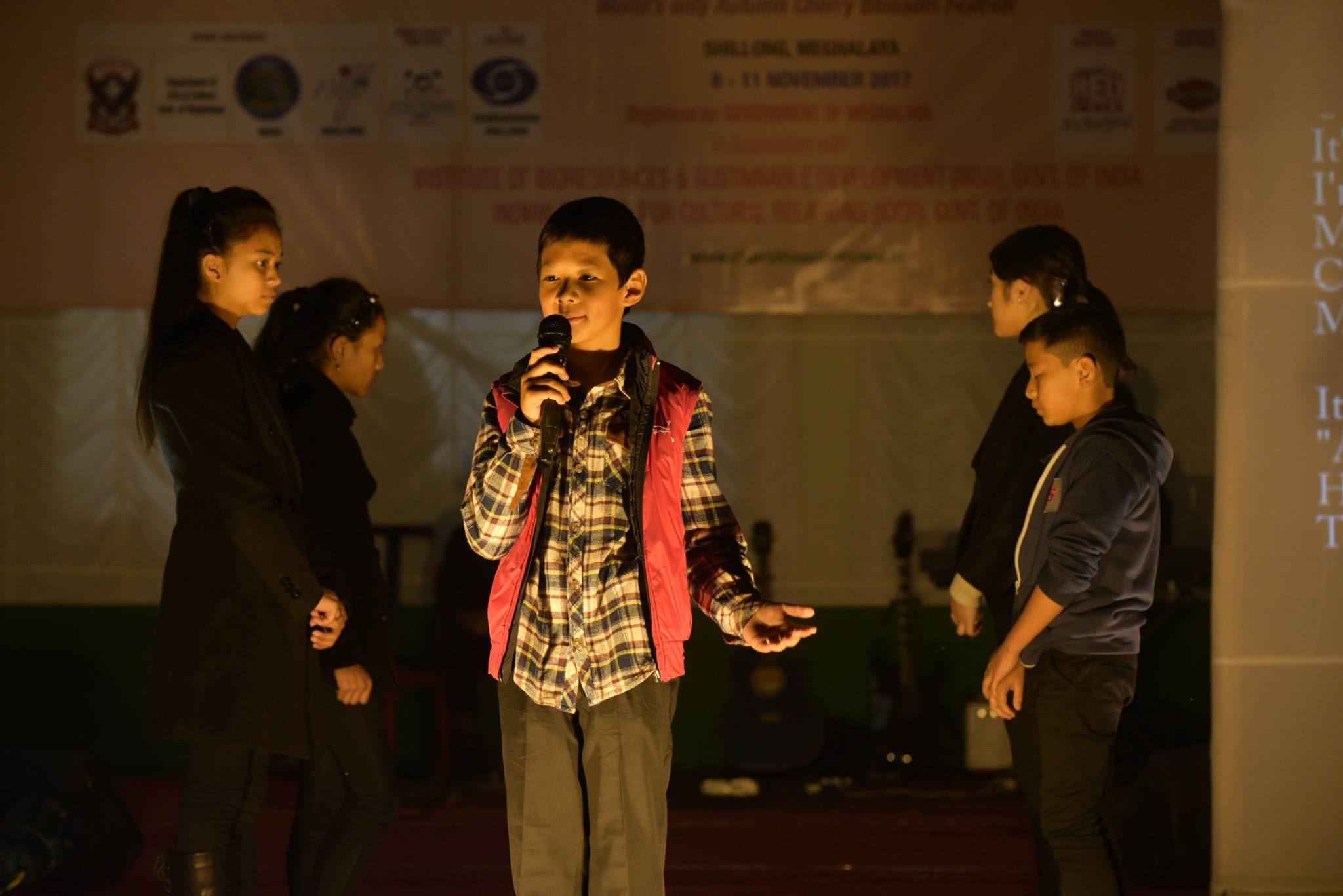
    The Storytelling session
    23737874_356064084820714_3565661621783748706_o
    The Chief Minister of Meghalaya
    23737840_356066868153769_1444030961921937630_o
    Purna Sangma, the Chief Minister performing at the event. Image from the official event page.


    The handicrafts and local produce for sale at the polo grounds.

    DSCN4567
    The East Khasi Hills

    As I made way through the East Khasi Hills, the hills came to life.

    DSCN4484
    the blossoming at the Wards lake

    DSCN4487

    DSCN4099
    An orchid in full bloom
    DSCN4211
    A blossoming tree adding colors to the azure November sky at the Polo Ground
    DSCN4513
    A bud full of blossoms
    DSCN4676
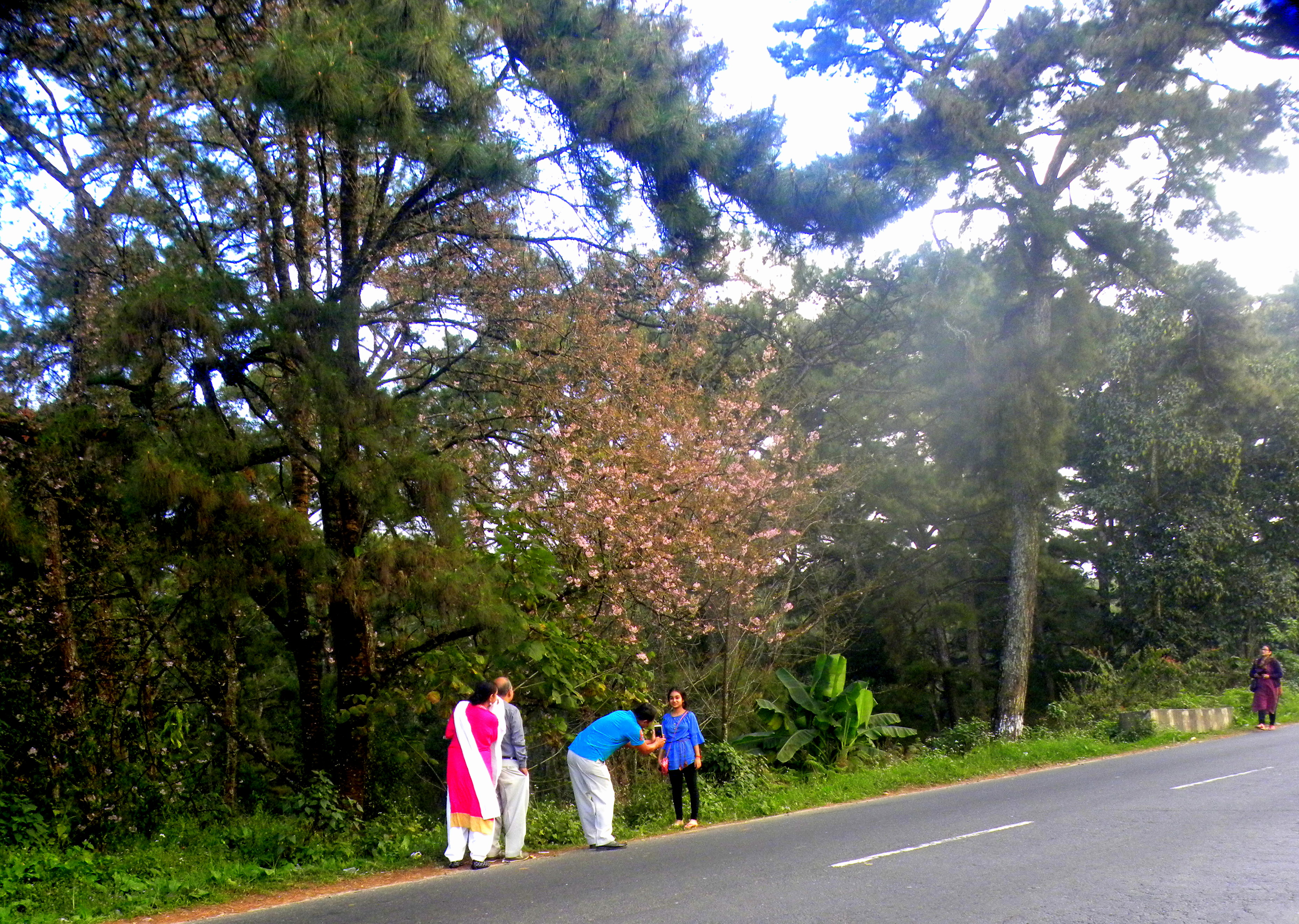
    on the road of colors
    RSCN4550
    loveliest of all the cherry blossom now
    DSCN4682
    a bunch of fresh blossoms
    DSCN4685
    the blooming state
    RSCN4691
    in full bloom

    By this time, the cherry blossom had begun and the Scotland of the East, transferred into a pink city.

    DSCN4536
    hanging from the bow
    DSCN4309
    the clouds at the Shillong peak
    DSCN4310
    A view from the Shillong peak
    DSCN4327
    parched on the way to the Shillong peak


    23484577_1588655777847667_491232318_o
    The passenger of life, resting at the Shillong peak
    DSCN4312
    the abode of clouds, Meghalaya

    Parched at the top of Shillong peak one gets an ethereal view of the pink city.

    It’s as if autumn and spring kiss and goes their separate ways here.

    23669049_355205498239906_8464606704891113133_o
    The pink city Shillong. Image courtesy the official event page

    2 worlds exist in the same place – the blossoming cherry flowers fall on heaps of autumn leaves and as you move towards Dawki, Cherapunji and Mawsingram you come across small huts and villages tucked in the hills.

    DSCN4253
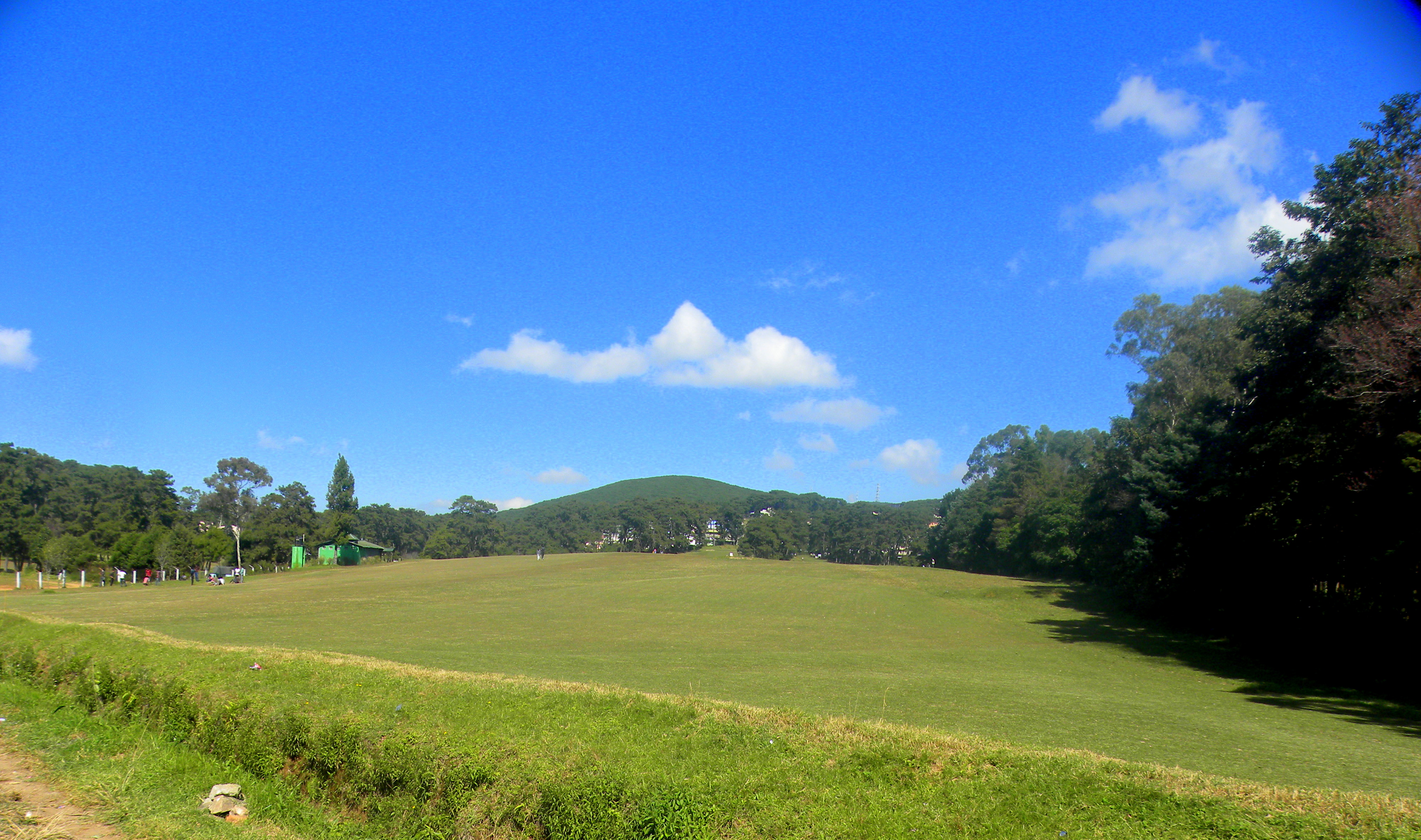
    The Golf Course
    DSCN4254
    The sprawling Golf Course
    DSCN4259
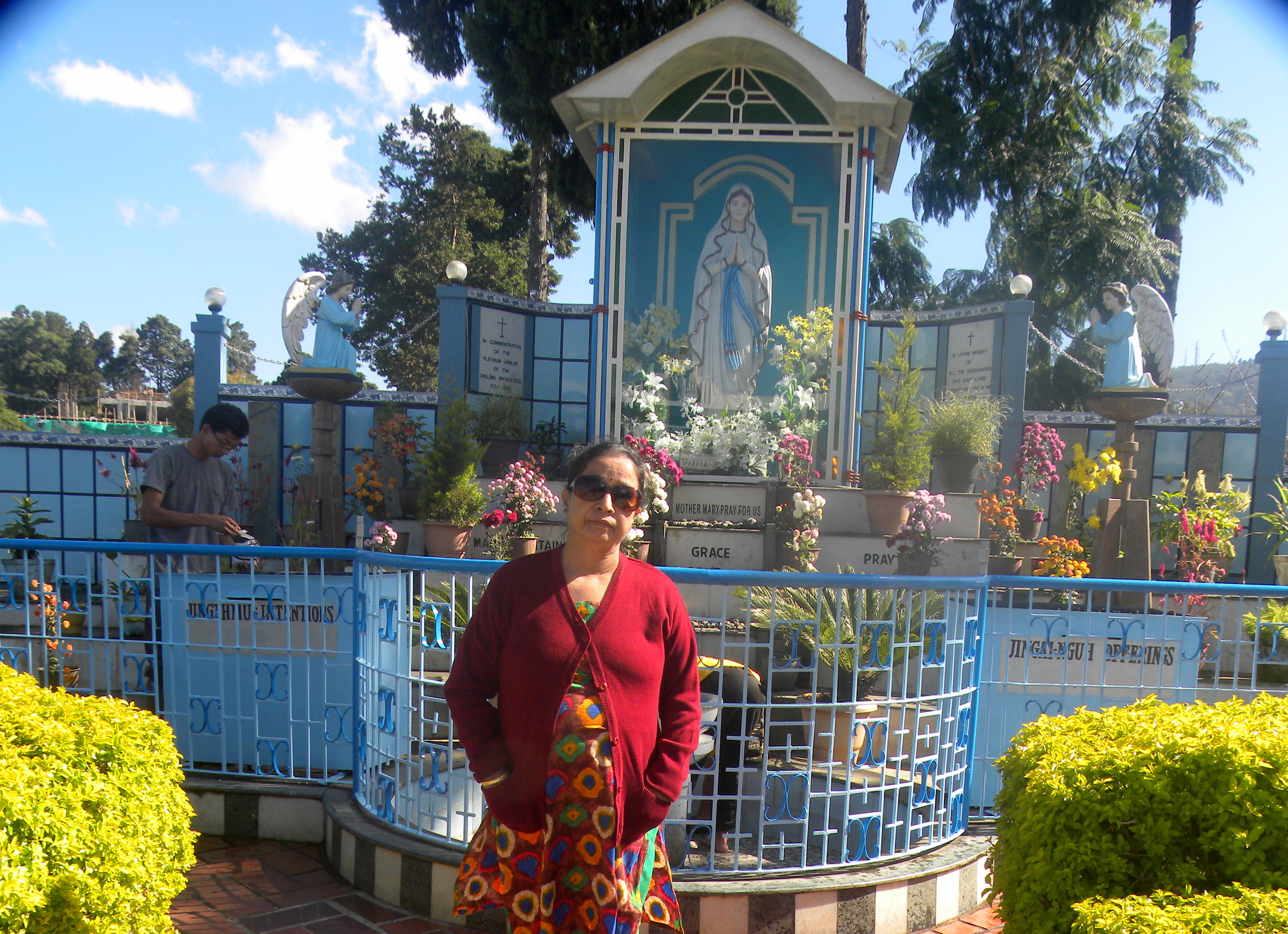
    The Don Bosco Church – 2nd oldest church in India
    DSCN4286
    My mother in front of the church
    DSCN4273
    Inside the church
    DSCN4266
    Christ, the savior
    DSCN4274
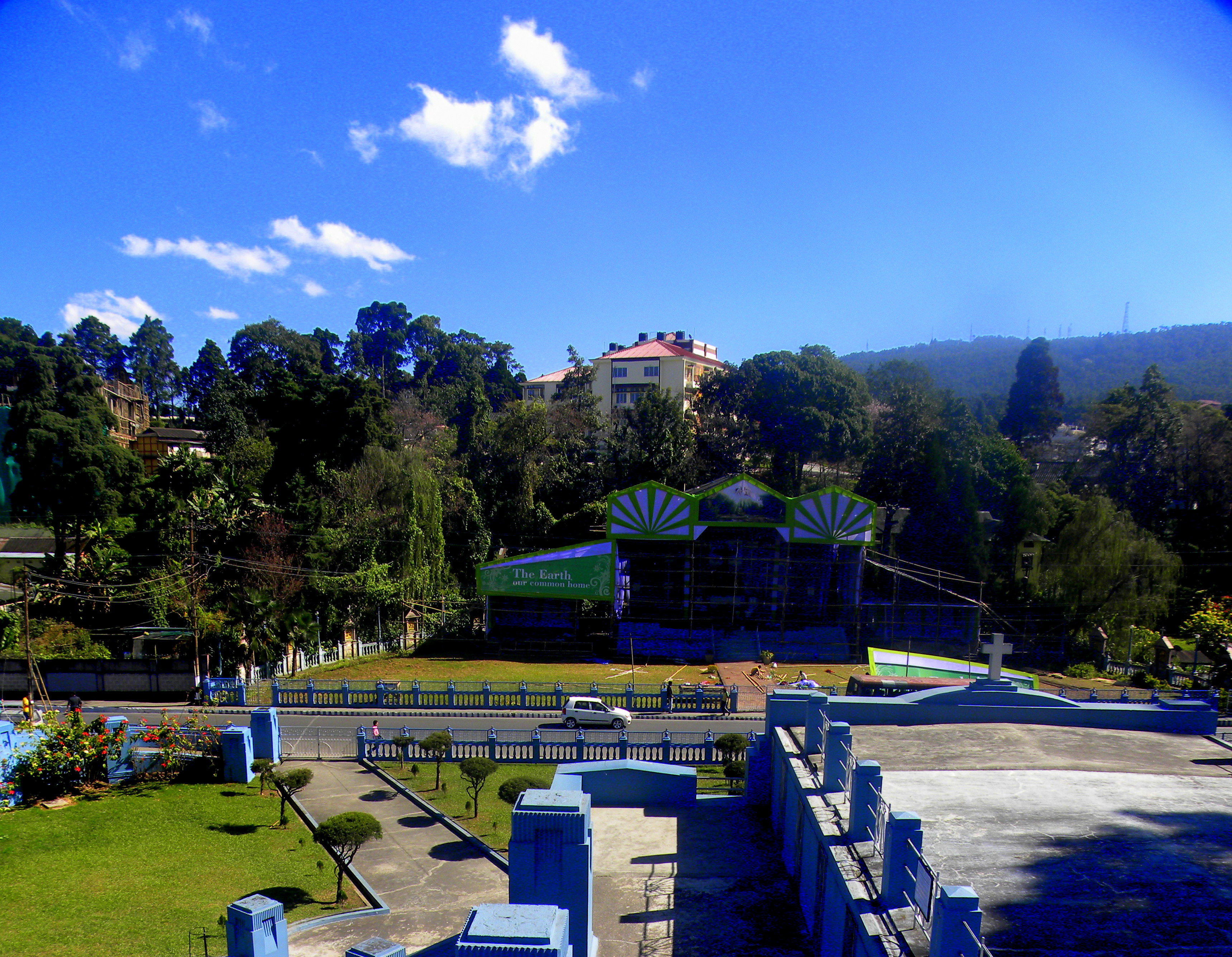
    A view from the church
    23483282_1588655784514333_410053221_o
    On the doorways of the church

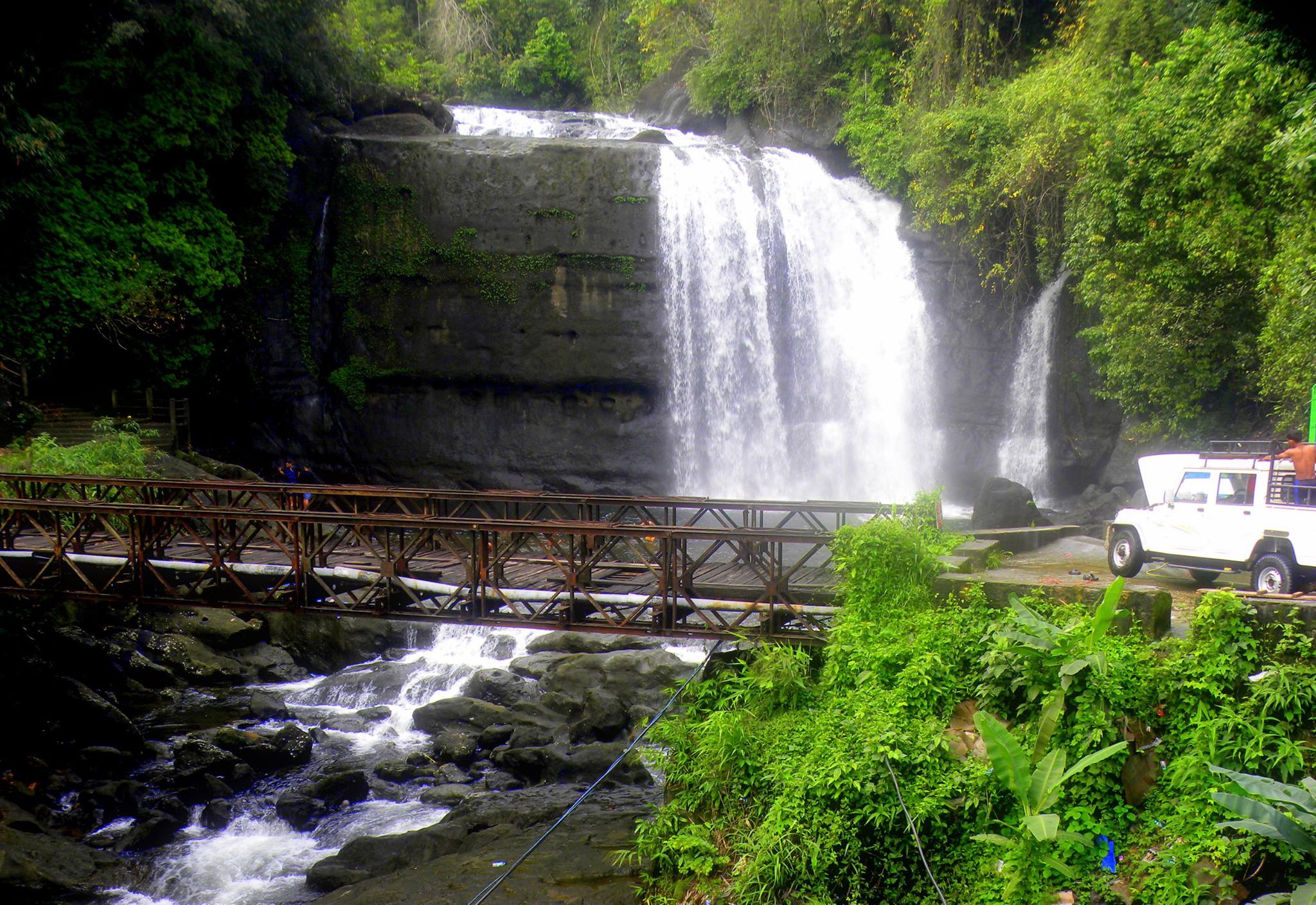
    The Elephanta Falls in Shillong

    DSCN4636
    The Umngot River at Dawki, Indo-Bangladesh Border in Meghalaya
    DSCN4597
    The Water is crystal clear

    DSCN4570

    DSCN4598
    People at Dawki
    DSCN4606
    The glistening waters of Dawki
    DSCN4599
    The simmering sunlight falling on the crystal clear water

    This slideshow requires JavaScript.

    Along the way, you find Mylliem, a region in the East Khasi Hills where children frequent hillside graveyards to offer their condolence. It’s as if they are waiting for a story to unfold. Mylliem is that story-teller, she tells the tale of regions – waterfalls, canyons, footbridges, and crystal clear shimmering water.

    18491642_1687733561253987_1597200792663661812_o
    On the way to cherapunji
    18491778_1688504271176916_1882873406005354913_o
    At the tip of the Seven Sisters
    18559021_1689015467792463_6202774628078040640_o
    The Seven Sister Waterfalls
    article-0-0DC4466600000578-957_964x516
    The Living Footbridge at Mawsynram Picture: The Daily Mail
    nelive
    The laitlum canyon of Meghalaya Picture: The Better India
    official festival 5
    On the way home I left the city in pink hues Picture: The official event page


    It’s a fortune teller’s land.

    The Pied Piper of Mylliem is waiting to enchant us here with her spell of magic – in the land of the fortune teller.

  • An Unperturbed Companionship

    A pale yellow morning,
    a dark-skinned girl was roaming around a crematorium looking for her father.
    It was her 15th day here, 2nd in this month.

    Roshmon frequented this crematorium. Her father was one of the Dom here.
    Dom, a person who is entrusted with the burning procedure of a funeral pyre.
    Theirs was a story of life amongst the dead.

    While her parents remained busy with funeral work Roshmon spent her day roaming around the crematorium befriending odd characters. Sometimes it was ‘Alice’ from the Wonderland. While at others it was ‘Swami And His Friends’ from Malgudi.

    Roshmon was 12, going to be 13 next month. Quite a grown-up lady she was – or so she believed. The young and naïve child behaved like a grown-up middle-aged woman with an air of wisdom and philosophy. A close association with the living dead and the heartbeats of the dead have made her accustomed to certain realities of our strange world.
    Hence, she valued both – life and death. The latter to a greater extent. She fiercely protected her animal friends – even the dead ones. Squirrels, rats, cats, dogs, sparrows – anything that inhabited the crematorium were her friends. Anyone causing any harm to them whether dead or living came under her wrath.

    Her friend’s in school took advantage of this. They bullied her by calling her ‘Maa Kali’ – the Goddess of Death. Even the local workers of the crematorium affectionately called her their ‘Resident Little Evil Goddess’. But whenever you ask her and you will get to know who she actually is.

    ‘I am the protector of the dead. I am the death-eater’, pat came her reply.
    Indeed she was the death-eater. Protecting both the living and the non-living from death.
    To her, death resembled those houses. Houses which stand-alone desolated –inhabited but without a heartbeat. As if the people came back only to stain those walls and not to converse with them. She decided to be a designer of houses. A house which wasn’t stagnant like death.
    An architect of houses with a heartbeat that would be her profession.
    Little Roshmon living and dreaming of an ideal land of heartbeat didn’t have any idea what the future had in store for her.


    Her birth month December came and so did the news of the disaster. Her father had lost his job at the crematorium. They have taken new people in his place – people with knowledge of machines. Unable to bear the expenses of the school, her parents withdrew her from school.

    ‘I want to go to school. When will I go back?’ she demanded to know.

    Her parents remained silent.

    Day after day they silenced her with one excuse or the other.
    Sometimes, it was ‘let the rain settle down’ and at others, it was ‘ next month you’ll go to a bigger school’. 3 months passed like this, Roshmon was increasingly becoming reckless. Her playmates began taunting by calling her ‘The Vagabond Goddess’.

    Then one day, the truth revealed itself unexpectedly. It was on the eve of her 15th visit to the crematorium. As usual, she came there looking for her father but instead she overheard a conversation. Rakesh and Shamu, 2 of her father’s subordinates were busy conversing. They didn’t notice the child roaming nearby.

    ‘Ah! These machines, they are taking up all our jobs,’ said Shamu.

    ‘I don’t know what will happen next!’ said Rakesh anxiously.
    ‘Already, people like Danny Kaka have been replaced’ said Shamu. (Danny Kaka, Danny Ruth is Roshmon’s father).

    ‘What can he do? He is an old haggard. Unable to cope up with modern techniques. Electrical funeral pyre is the latest trend’ said Rakesh.

    ‘But what about the rituals and the mantras? Will they replace them with recorded versions of it?’ asked Shamu.

    ‘Who knows? I have even heard about televised funeral rites system’ said Rakesh.

    ‘ Funeral Rites on Television!’ exclaimed Shamu.

    ‘Yes, They call it video calling. The friends and relatives of the dead burn a paper or straw in their name while his body is burnt here and the whole thing is visible on T.V.’ said Rakesh.

    ‘What a tragedy to die like this! I pity those machine led people’ said Shamu disgustingly.

    Roshmon ran away after hearing all this. She cried inconsolably that day. Nobody informed her of those dreadful machines. The wretched little devils that ate up her father’s job and left them to a life of uncertainty.


    “I will work. I will gather all the books and read up myself. I will win that scholarship’ thought, Roshmon.
    “Life may not be easy but I’ll overcome the odds. I will pass this exam” resolved, Roshmon.

    She began working as a cleaner and sweeper in the local library. The clever little girl that she was. She knew when and how to manage time, and how to acquire knowledge. She worked all through the day and borrowed books from the library in return for her daily wages. During the day she cleaned the dust gathered on the books and at night the books came to clean up her future. She tried hard to ace in her studies. She burnt the midnight oil to win that scholarship.

    Months of hard work paid off and she passed the entrance test!
    But alas! God had something else planned for her. She was struck by another blow.

    The School incurred a loss and decided to discontinue the scholarship program.
    All hell broke onto her. She was at her wit’s end.
    Life wasn’t that easy after all. It was an unexpected expectation. An unlikely set of examinations.

    ‘Life is an exam where the syllabus is unknown and question papers are not set. But I can pass this exam’ she thought.

    She passed the entrance exam but failed in the exam of life.

    ‘Or perhaps this is an exam by itself?’
    ‘God is testing me. He is making me strong for something better’, thought Roshmon.
    Determined, she started looking for other such scholarships.

    ‘There has to be some school who will accept me’ thought she.

    Indeed there was. It only needs to be searched and God helps those who help themselves.
    She started gathering information. The machines helped her in this process. She picked up some names from television commercials that run on a store nearby. Every day she visited that store till she gathered enough information.

    But this wasn’t enough. She required more information in order to prepare for the day.
    These schools were bigger and better. International Schools with bigger opportunities. They require more hard work but she knew that she could achieve this. It is her last chance to be the architect of houses with a heartbeat.

    ‘It seems tough but not impossible’, Roshmon said to herself.
    She required some help. Roshmon gathered the courage to confront her friends. Some of them ridiculed her while other discouraged her but few stood by her. With the help of these trusted friends, she gathered all the information about those big schools.

    She started working hard. She worked more to gather the necessary books for her studies. Thus started a long drawn battle. While her parents tried to restore their lost livelihood, she went on working and studying hard.

    One year passed by, Roshmon took the scholarship test for 6th Standard. She should have been in the 8th standard today if all had gone well that day. But time had something else in store for her. She stood through the test of time and won the race. She has not only passed the examination but has topped it.

    She came through with flying colours. Not only did she get in but she became the star student of her class.
    Closer home, her family was reeling under pressure. Roshmon took charge here as well. She befriended the machine this time. She took on the task of teaching the life of machines to her parents.

    The vitality and essentiality of modern technologies and machines weren’t unknown to her. She was herself a product of it.
    Soon her parents realized the essence of the machine. They became aware of the beneficial aspects of the electrical funeral pyre. They understood it was there to ease out their dreadful work.

    It’s not Man or Machine.

    It is Man and Machine.

    Thus, they started learning the new ways of life and went back to their job. Gradually, they made peace with the machine. Proper training and understanding made it a boon for them. The things they were cursing as devils soon became their messiah.

    Seeing them working peacefully, many others started to return to their previous work. It was no longer the story of one Danny Ruth and Roshmon. Several Shambhu, Dinanath, Dinesh, Omprakash, Danny,Victor was waiting to return. Not just in the crematoriums but to the jute mills, factories, and warehouses. It was the story of every working class people.

    So life returned to its natural form. In the end, it wasn’t the syllabus we desired to learn but the syllabus we need to learn that matters. Life’s syllabus was that. It was all planned.

    Both in death and in life, machines are the friends we seek. The Almighty has made us that way.

    Man and Machine.

    Ours is an inevitable friendship.

    An unperturbed companionship.

  • Understanding AIDS & Its Virus.

    AIDS or Acquired Immuno Deficiency Syndrome is a disease that is troubling this world for more than 3 decades since it’s discovery in 1981. More than 20.9 million people are inflicted by the disease as reported by WHO in mid-2017. The disease is caused by a Virus named Human Immuno Deficiency Virus, which attacks our immune system making us vulnerable to diseases. AIDS patients suffer from a range of secondary diseases like Tuberculosis, Hepatitis or Cancer and eventually die of them.  Owing to the seriousness of the disease, the World Health Organization ( headquartered in Geneva ), has designated December 1 as a World AIDS Day in order to highlight the menace of this disease and make people aware of it.

    However, proper knowledge of the disease requires a thorough understanding of the HIV virus. So, today we are going for an in-depth analysis of HIV virus, its modes of action and what it means for us.

    HUMAN IMMUNODEFICIENCY  VIRUS (HIV)

    INTRODUCTION

    hiv
    HIV Virus

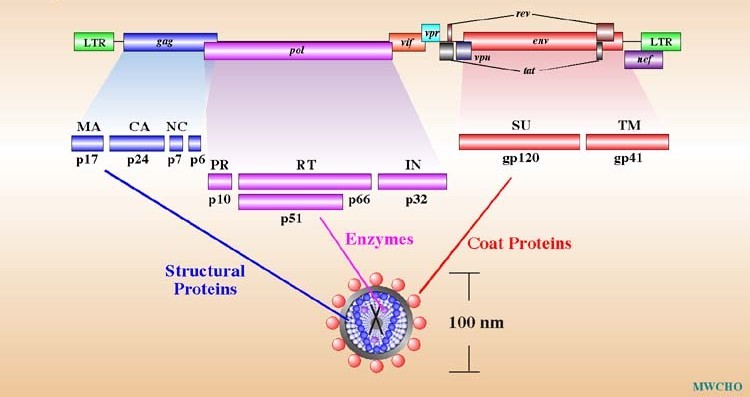
    Human immunodeficiency virus (HIV) is a retrovirus belonging to the category lentivirus. This virus is the causative agent of the disease AIDS (Acquired Immuno Deficiency Syndrome). HIV is one of a group of atypical viruses called retroviruses that maintain their genetic information in the form of ribonucleic acid (RNA). Through the use of an enzyme known as reverse transcriptase, HIV and other retroviruses are capable of producing deoxyribonucleic acid (DNA) from RNA, whereas most cells carry out the opposite process, transcribing the genetic material of DNA into RNA. The activity of the enzyme enables the genetic information of HIV to become integrated permanently into the genome (chromosomes) of a host cell.The disease was first recognized in the USA in 1981.The virus was first isolated by US scientist Robert Gallo and French scientist Luc Montagnier in 1983. In 1986 AIDS was identified as an unknown disease in India. HIV infections may be caused by one of two retroviruses, HIV-1 or HIV-2. HIV-1 has caused a worldwide epidemic, but HIV-2 tends to be limited to West Africa. HIV is a complex virus which has RNA as the genetic material, the enzyme reverse transcriptase, capsid and a viral envelope containing glycoprotein surface receptors gp120 and gp41.

    HIV GENOMIC STRUCTURE

    The HIV genome has the following genes:

    Structural genes:

    hiv1
    The HIV Genomic Structure
    • gag: It is a group of antigen gene found in all retroviruses. It makes various proteins necessary to protect the virus. In HIV it has 3 parts MA (matrix)p17, CA (capsid)p24 and nucleocapsid.
    • pol: This is the polymerase gene found in all retroviruses. It makes enzymes necessary for viral replication. In HIV it has 3 parts: PR (protease), EN(endonuclease). RT(reverse transcriptase) and IN(integrase).
    • env: this is the envelope gene which makes the viral envelope protein. In HIV it has 2 parts: SU(surface envelope) and TM(transmembrane envelope).

    Regulatory genes:

    • tat: the transactivator gene influences the functions of genes some distance away. It controls the transactivation of all HIV proteins.
    • rev: a differential regulator of expression of viral protein genes.

    Accessory genes:

    • vif : the virus infectivity factor gene is required for infectivity.
    • nef : the negative regulator factor gene which retards HIV replication.
    • vpr: the virus protein R gene has an undetermined function.
    • vpu: the virus protein U gene is required for efficient viral replication and release. It is found only in HIV-1
    • vpx: the virus protein X gene has an undetermined function. It is found only in HIV-2 and SIV.
    hiv genome
    The Genome Organization of HIV

    THE VIRAL INFECTION

    viral infectionThe primary hosts for HIV are the white blood cells variously called helper T lymphocytes, helper T cells, or CD4+ T cells. These cells are important components of the immune system that are normally responsible for activating the responses of many other immune cells. Helper T cells that become infected with HIV rapidly die. Soon after primary infection, the body is usually able to compensate for the loss of infected T cells by producing them in greater quantities, at which time individuals infected with HIV are asymptomatic. Over time, however, the virus becomes increasingly acute and there is a slow decline of helper T cells. Consequently, the number of helper T cells in the body (termed the CD4 count) is generally utilized to gauge the advance of the virus. A CD4 count of less than approximately 200 cells per microliter of blood may be accompanied by a variety of opportunistic infections and is considered the final stage of infection. The persistent barrage of such infections is what typically leads to the death of AIDS patients.

    Mechanism of entry of virus into the cell

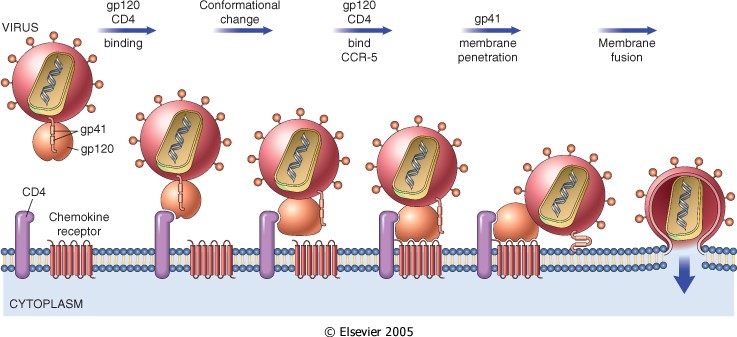
    HIV is a relatively complex virus that is able to infect helper T cells chiefly due to a glycoprotein embedded in its envelope called gp120 (see Figure 1) that attaches to CD4, a protein found on the surfaces of the T cells. Entry of HIV into a host cell is also thought to involve a co-receptor on the cell surface, either CCR5 or CXCR4, which typically function as receptors of chemokines. The HIV virus envelope is a derivative of the plasma membrane of a host cell, obtained via budding. When HIV attempts to enter a cell, interactions between cell surface molecules and viral envelope proteins allow the envelope to fuse with the cell membrane. The envelope protein called gp41 is known to play an important role in this process.

    entry mechanism
    Attachment, Fusion and Viral Genome Entry

    Mechanism of Infection

    Once in the body, HIV attaches to several types of white blood cells. The most important are certain helper T lymphocytes. Helper T lymphocytes activate and coordinate other cells of the immune system. On their surface, these lymphocytes have a receptor called CD4, which enables HIV to attach to them. Thus, these helper lymphocytes are designated as CD4+.

    life cycle
    The Viral Life Cycle

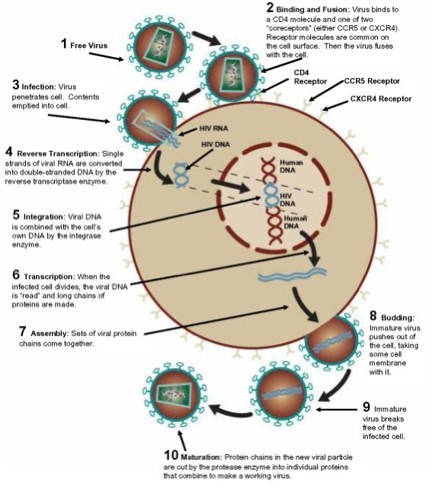
    HIV stores its genetic information as ribonucleic acid (RNA). Once inside a CD4+ lymphocyte, the virus uses an enzyme called reverse transcriptase to make a copy of its RNA, but the copy is made as deoxyribonucleic acid (DNA). HIV mutates easily at this point because reverse transcriptase is prone to making errors during the conversion of viral RNA to DNA. These mutations make HIV more difficult to control—by the body’s immune system and by drugs.

    The viral DNA copy is incorporated into the DNA of the infected lymphocyte. The lymphocyte’s own genetic machinery then reproduces (replicates) the virus. Eventually, the lymphocyte is destroyed. The thousands of new viruses produced by each infected cell infect other lymphocytes and can destroy them as well. Within a few days or weeks, the blood and genital fluids contain many viruses, and the number of CD4+ lymphocytes may be reduced substantially. Because the number of viruses in blood and genital fluids is so large so soon after HIV infection, newly infected people can readily spread HIV to other people.

    When HIV infection destroys CD4+ lymphocytes, it weakens the body’s immune system, which protects against many infections and cancers. This weakening is part of the reason that the body is unable to eliminate HIV infection once it has started. However, the immune system is able to mount some response. Within a month or two after infection, the body produces lymphocytes and antibodies that help lower the amount of HIV in the blood and keep the infection under control. For this reason, untreated HIV infection continues for an average of about 10 years (ranging from 2 to 20 years) before causing symptoms.

    CD4 COUNT:

    The number of CD4+ lymphocytes in the blood (the CD4 count) helps determine how well the immune system can protect the body from infections and how severe the damage done by the HIV is. Healthy people have a CD4 count of about 800 to 1,300 cells per microliter of blood. Typically, 40 to 60% of CD4+ lymphocytes are destroyed in the first few months of infection. After about 3 to 6 months, the CD4 count stops falling so quickly, but without treatment, it usually continues to decline at rates that vary from slow to rapid.

    If the CD4 count falls below about 200 cells per microliter of blood, the immune system becomes less able to fight certain infections (such as the fungal infection that causes Pneumocystis jirovecii pneumonia). These infections do not usually appear in people with a healthy immune system. Such infections are called opportunistic infections because they take advantage of a weakened immune system. A count below about 50 cells per microliter of blood is particularly dangerous because additional opportunistic infections that can rapidly cause severe weight loss, blindness, or death commonly occur. CD4 count can be measured by Flow-cytometry.

    VIRAL LOAD:

    The amount of HIV in the blood (specifically the number of copies of HIV RNA) is called the viral load. Viral load represents how quickly HIV is replicating. When people are first infected, the viral load increases rapidly. Then, even without treatment, it drops to a lower level, which remains fairly constant, called the setpoint. This level varies widely from person to person. Viral load also indicates how contagious the infection is and how fast the infection is likely to worsen.

    During successful treatment, the viral load decreases to a very low or undetectable level. However, inactive (latent) HIV is still present within cells, and if treatment is stopped, HIV starts replicating. An increase in the viral load during treatment indicates that the HIV has developed resistance to drug treatment, that people are not taking the drugs or both.

    MODES OF TRANSMISSION

    • Sexual transmission, the presence of STD increases the likelihood of transmission.
    • Exposure to infected blood or blood products.
    • Sharing contaminated needles (IV drug users).
    • Transplantation of infected tissues or organs.
    • Mother to the fetus, perinatal transmission variable, dependent on viral load and mother’s CD 4 count.
    Transmission
    Transmission of the virus

    SYMPTOMS

    When initially infected, many people have no noticeable symptoms, but within a few weeks, fever, rashes, swollen lymph nodes, fatigue, and a variety of less common symptoms may develop. Symptoms of initial (primary) HIV infection last from a few days to 1 to 2 weeks. The symptoms disappear, but lymph nodes often remain enlarged, felt as small, painless lumps in the neck, under the arms, or in the groin. People can be infected with HIV infection for years—even a decade or longer—before developing symptoms. However, the first symptoms may be those of AIDS. AIDS is defined as the development of very serious opportunistic infections or cancer—the ones that usually develop only in people with a CD count of less than 200. Before AIDS develops, many people feel well, although some develop a variety of vague symptoms such as weight loss, fatigue, recurring fever or diarrhea, anemia, and thrush (a fungal infection of the mouth or vagina).

    cdc-hiv-and-youth-infographic

    Symptoms of AIDS are usually those of the specific opportunistic infections and cancers that develop. For example, people may have white patches in their mouth due to thrush or pain and rash due to herpes zoster.

    However, HIV can also cause symptoms when it directly infects parts of the body:

    • Brain:

      Memory loss, difficulty thinking and concentrating, or both, eventually resulting in dementia, as well as weakness, tremor, or difficulty walking

    • Kidneys:

      Swelling in the legs and face, fatigue, and changes in urination (more common in blacks than in whites), but often not until the infection is severe

    • Heart:

      Shortness of breath, cough, wheezing, and fatigue (uncommon)

    • Genital organs:

      Decreased levels of sex hormones, which, for men, leads to a decreased interest in sex (common).

    Common Opportunistic Infections Associated with AIDS
    Infection Description Symptoms
    Candidal esophagitis A yeast infection of the esophagus Painful swallowing and burning in the chest
    Pneumocystis jirovecii pneumonia An infection of the lungs with the fungusPneumocystis jirovecii Difficulty breathing, cough, and fever
    Toxoplasmosis Infection with the parasite Toxoplasma gondii, usually in the brain Headache, confusion, lethargy, and seizures
    Tuberculosis Infection of the lungs and sometimes other organs with tuberculosis bacteria Cough, fevers, night sweats, weight loss, and chest pain
    Mycobacterium avium complex infection Infection of the intestine or lungs with bacteria that resemble tuberculosis bacteria Fever, weight loss, diarrhea, and cough
    Cryptosporidiosis Infection of the intestine with the parasiteCryptosporidium Diarrhea, abdominal pain, and weight loss
    Cryptococcal meningitis Infection of the lining of the brain with the yeast Cryptococcus Headache, fever, and confusion
    Cytomegalovirus infection Infection of the eyes or intestinal tract with cytomegalovirus Eye: Clouding of vision or blindness

    Intestinal tract: Diarrhea and weight loss

    DIAGNOSIS

    Simple, screening tests that detect antibodies to HIV are done. Tests may be done on a blood sample in the laboratory or on a blood or saliva sample in the doctor’s office. If screening test results are positive, they are confirmed by a more accurate, specific test such as the Western blot. Often, these tests are not positive in the first weeks up to 2 months after initial HIV infection because antibodies to HIV are not yet being produced. Tests include the following:

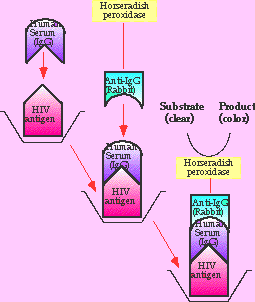
    • Enzyme-linked immunosorbent assay (ELISA):

      ELisa
      Method of ELISA test

      This screening test is often used to detect HIV antibodies, but it requires complex equipment.Antibodies detected in ELISA include those directed against: p24, gp120, gp160 and gp41.Different types of ELISA techniques used:

      indirect

      competitive

      sandwich

    ELISAs are for screening only, false positives do occur and may be due to AI disease, alcoholism, syphilis, and immunoproliferative diseases.

    Other screening tests:.

    Agglutination tests

    Agglutination test
    Particle Agglutination Test

    using latex particles, gelatin particles or microbeads are coated with HIV antigen and will agglutinate in the presence of antibody.

    Dot-Blot

    dit bot

    Testing utilizes paper or nitrocellulose impregnated with antigen, patient serum is filtered through, and anti-antibody is added with an enzyme label, the color change is positive.

    Western blot:

    This test is usually done to confirm the diagnosis when screening test results are positive. It is more difficult to do than the screening tests but is more accurate.It utilizes a lysate prepared from HIV virus.The lysate is electrophoresed to separate out the HIV proteins (antigens).The paper is cut into strips and reacted with test sera.After incubation and washing anti-antibody tagged with radioisotope or enzyme is added.Specific bands form where the antibody has reacted with different antigens.The following antigens must be present: p17, p24, p31, gp41, p51, p55, p66, gp120 and gp160. Depending on the particular antibodies in the sample, reactivities with the separated antigenic components result in band profiles.

    western blot
    Interpretation of Western Blot

    The type of profile (the combination and intensity of bands that are present) determines whether the individual is considered positive for antibodies to HIV. The classification of Western blot results is determined by certain criteria. Most institutions now follow the CDC guidelines, which require reactivity to at least 2 of the following antigens: p24, gp41, gp120/160 for a positive  It is now universally accepted that a negative result is the absence of all bands. Two organizations, however, including the World Health Organization (WHO), suggest that results also can be reported as negative if there is only a very weak p17 band. Indeterminate classifications occur when there is reactivity to 1 or more antigens, but not fulfilling the criteria for positivity.

    • Real-time PCR:

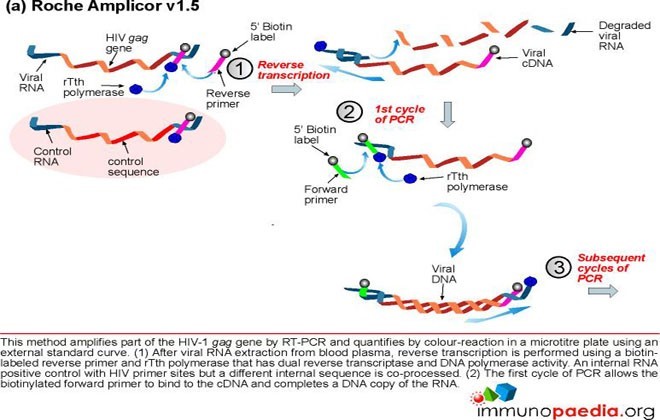
      This is a laboratory technique which directly estimates the presence of the viral genome over the cycle of PCR (Polymerase Chain Reaction, a method replicating DNA/RNA in vitro i.e., in the lab).

    PCR
    PCR Diagnosis of HIV

    TREATMENTS

    Different types of  HIV/AIDS management drugs work uniquely to counter the virus. Combining several types of these drugs help minimize chances of the virus developing resistance top one drug (Briz et. al., 2006).

    Types of the HIV Drugs

    inhibitors
    HIV Drugs and their targets
    • Entry or fusion inhibitors

    •  Non-nucleoside reverse transcriptase inhibitors (NNRTIs)

    •  Protease inhibitors (PIs)

    • Nucleoside reverse transcriptase inhibitors (NRTIs)

    • Integrase inhibitors

    Entry or fusion inhibitors


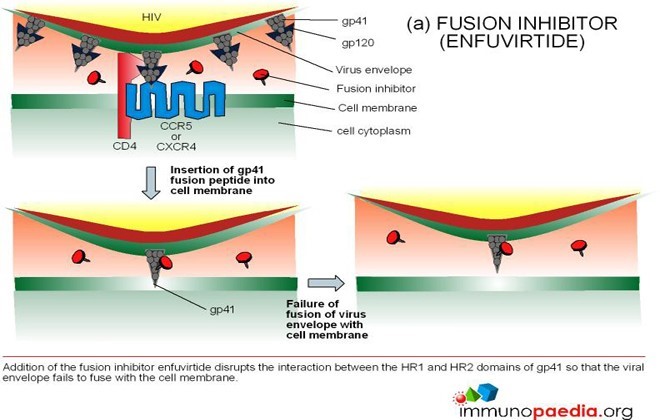
    Mechanism of action of fusion inhibitors

    fusion inhibitors
    Fusion Inhibitors

    Entry or fusion inhibitors prevent HIV from entering CD4 cells. Contact between gp120-CD4 complex and chemokine receptor CCR5 or CXCR4 causes a change that the viral membrane to a fusogenic state which control the fusion process. Meanwhile, gp41 reveals its N-terminal, which goes through the fusion peptide into the cell outer covering. Gp41 restructure and this causes the HR1 and HR2 to come together and a thermostable six-helix structure necessary in viral and cellular membrane fusion forms. It is this change in free energy that goes with the emergence of the six-helix bundle that enables the fusion pore to form leading to viral capsid’s entry into the cell of interest (Poveda, Briz & Soriano, 2005).

    Non-nucleoside reverse transcriptase inhibitors (NNRTIs)


    Mechanism of action

    NNRTIs work by disabling a protein that HIV needs to replicate. The reverse transcriptase consequently blocks it from altering the RNA to DNA. In effect, this strengthens the genetic material of the cell such that the genetic information of HIV cannot cause it to replicate the virus.

    nnrti
    NNRTI mode of action

    Protease Inhibitors (PIs)


    Mechanism of action

    protease inhibitor

    Protease inhibitors serve to prevent infected T-cells from replicating the virus. They cover the active sites of the protease enzyme in order to inhibit the HIV polyprotein. This brings down the level of the virus in the blood, boosting the patient’s immune system.

    Resistance to protease inhibitors comes from mutations of the viral protease enzyme (Reeves & Piefer, 2005).

    Nucleoside reverse transcriptase inhibitors (NRTIs)


    Mechanism of action

    nrti
    NRTI mode of action

    NRTIs are carried by the host cell and are later phosphorylated by cellular enzymes, which change them to their active form – NRTI triphosphates. Stability of NRTI and how efficiently it is converted into NRTI triphosphate are key determinants of the level of the inhibitor in the bloodstream required for the effect on HIV (Briz et. al., 2006).

    Integrase inhibitors


    Mechanism of action

    Integrase inhibitors embed themselves on reverse transcriptase after it has created the viral DNA strand and hooks onto the last two nucleotides from the end of the DNA strand. This is termed as 3A2 processing. After this, integrase inhibitor forms a pre-integrase complex that carries a ring-shaped viral DNA and host proteins. It is this pre-integrase complex that helps the viral DNA pass through cell cytoplasm and into the cell nucleus. The integrase inhibitor prevents strand transfer and viral replication (Reeves & Piefer, 2005).

    integrase inhibitors
    Sit of action for integrase inhibitors

    The AIDS Cocktail


    • highly active antiretroviral therapy, or HAART. HAART is a potent combination of at least three active antiretroviral medications (ARV).
    • HAART is popularly called the “AIDS cocktail” because of its mix of drugs.
    • Mainly a mix of 3 types of drugs is used NNRTIs, protease and integrase inhibitors.
    • Example: Raltegravir (integrase inhibitor)+ Tenofovir (NRTIs) + Emtricitabine  (NRTIs).

    Viral Infection in case of CCR5 mutation :

    • CCR5 has multiple variants in its coding region, the deletion of a 32-bp segment results in a nonfunctional receptor, thus preventing HIV R5 entry
    • 2 copies of this allele provide strong protection against HIV infection. This allele is found in 5–14% of Europeans but is rare in Africans and Asians.
    • CCR5-Δ32 decreases the number of CCR5 proteins on the outside of the CD4 cell, which can have a large effect on the HIV disease progression rates.
    • Multiple studies of HIV-infected persons have shown that presence of one copy of this allele delays progression to the condition of AIDS by about two years.
    • It is possible that a person with the CCR5-Δ32 receptor allele will not be infected with HIV R5 strains.
    • A genetic approach involving intrabodies that block CCR5 expression has been proposed as a treatment for HIV-1 infected individuals.[When T-cells modified so they no longer express CCR5 were mixed with unmodified T-cells expressing CCR5 and then challenged by infection with HIV-1, the modified T-cells that do not express CCR5 eventually take over the culture, as HIV-1 kills the non-modified T-cells. This same method might be used in vivo to establish a virus resistant cell pool in infected individuals.

    This hypothesis was tested in an AIDS patient who had also developed myeloid leukemia, and was treated with chemotherapy to suppress cancer. A bone marrow transplant containing stem cells from a matched donor was then used to restore the immune system. However, the transplant was performed from a donor with 2 copies of CCR5-Δ32 mutation gene. After 600 days, the patient was healthy and had undetectable levels of HIV in the blood and in the examined brain and rectal tissues. Before the transplant, low levels of HIV X4, which does not use the CCR5 receptor, were also detected. Following the transplant, however, this type of HIV was not detected either, further baffling doctors. However, this is consistent with the observation that cells expressing the CCR5-Δ32 variant protein lack both the CCR5 and CXCR4 receptors on their surfaces, thereby conferring resistance to a broad range of HIV variants including HIV X4. After three years, the patient has maintained the resistance to HIV and has been pronounced cured of the HIV infection.

    Enrollment of HIV-positive patients in a clinical trial was started in 2009 in which the patients’ cells were genetically modified with a zinc finger nuclease to carry the CCR5-Δ32 trait and then reintroduced into the body as a potential HIV treatment

    aids

    suniti
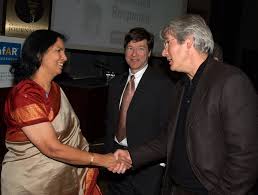
    Dr. Suniti Solomon with Richard Gere

    Hence, HIV has many checks and balance which makes treatment for the disease quite difficult but with increasing time it has become more and easier. With proper treatment a sustainable life is possible, even marriage is possible if the match-making is done by comparing their CD4 count, as shown by Dr. Suniti Solomon, the pioneer who discovered the disease in Tamil Nadu, India. The documentary “Lovesick” highlights this aspect.

    Although, Padma Shri Dr. Suniti Solomom her institute YRG Care survives giving hope to millions. One just needs to reach out! Dial 044-33125000 to get any kind of assistance. http://www.yrgcare.org/contact-us/

    And for those looking for a platform to meet people from the community Positive Sathi, a matrimonial website for HIV positive people is here. 


  • দেশ

    কথা ছিল দেখা হবে সাগরের পরে,
    নীল মেঘের দেশে যে দিন ফুটবে তারা হয়ে
    ভরা বর্ষার গাঙে দুই দৃষ্টি দেখবো এক সাথে,
    আমাদের যা গেছে সে সকলই তারা নিয়েছে আপন করে


    কথা ছিল দেখা হবে সাগরের পরে,
    তুমি থাকবে দাড়ায়ে আমার শিহরে
    আমাদের কথার ফাঁকে কাটবে রাত্রি,
    তোমার আমার মাঝে ফুটবে ভোরের সুভ্রাতি


    কথা ছিল দেখা হবে সাগরের পরে,
    নিদ্রা মগ্ন থাকবে যখন রাত্রি
    কথা ছিল দেখা হবে যখন আসবে একাকী,
    পলাতক মেঘ হয়ে বর্ষিব সেই দিন

    কথা ছিল দেখা হবে আমার দেশের পরে,
    বেষ ছাড়বে যে দিন


    কথা ছিল দেখা হবে আমার দেশে এক দিন


    আগন্তুক

  • Mr. Robinson’s Gift


    It was a gloomy afternoon. A quiet little girl is looking from a broken window creek. She was looking at the deserted balcony of the house lying across the street. It is raining cats and dogs for 3 days straight. There’s hardly any activity on the road.

    An old feeble businessman lived across the street- an amiable man with a dark past. He has an illustrious family who has disowned him or he deserted them. One couldn’t tell the truth these days. Either way, Mr. Robinson was a lonely man. A man of few words by nature Mr. Robinson scarcely had any friends. He had only one friend in his solitary life.

    A child named Polly living with her parents across the street.

    Every day they spoke through the window creek. Mr. Robinson from his balcony and Polly from her room. The girl couldn’t speak and Mr. Robinson couldn’t hear. Together, they formed a lovely friendship that’s written in sign language.

    “How’s your school going?” inquired Mr. Robinson.

    “Ah! The usual clamoring about silly nothings”, answered Polly.

    “What happened to your mystery?” she enquired after a brief pause.

    “It’s still going strong. Got another piece of the puzzle, today” said Mr. Robinson.

    “What’s in it? How does it look? Did you recognize it? Can I see it” Polly bombarded Mr. Robinson with a string of questions.

    Thus went their routine conversation- the sweet nothing of the usual suspects.


    10-year-old Polly lived with her parents Amy and Daniel Hudson.  The Hudson daughter was quite a sleuth. Having survived solely on detective stories, Polly often behaved like a detective. She is always in search of a mystery. Mr. Robinson’s picture puzzle is her new mystery. She is hooked on those torn pictures, eagerly waiting for the next piece.

    It’s been a month since Mr. Robinson started receiving those torn pictures. At first, he disregarded them as a harmless prank. Later, it dawned on him that someone is trying to take revenge.

    “Who could it be?” he wondered.

    Surely, something from his glorious dark days.

    “They are a mystery by itself”, laughed Mr. Robinson.

    The business tycoon Jack Robinson had lived quite a flamboyant life in his younger days. Right from school to college to his early work – his mischievous always caught up with him.

    Since that day, he received a torn picture every Sunday.

    Last week, the torn picture showed a playground with 2 children standing – only their legs with track pants were visible. Every time Mr. Robinson tried to recognize it but he failed miserably. The picture had an unfamiliar familiarity which he couldn’t gauge. It was as if he was one of those headless children shown in the picture.

    This week he received another part of the torn picture. This time they were wearing trousers and standing in front of a school like building.  Still headless and without the name of the school building. The school symbol on their trousers was blackened by a marker. As if someone wanted to hide it.

    The picture came with a note this time. It had a popular nursery rhym written on it.

    Jack and Jill went up the hill

    To fetch a pail of water

    Jack fell down and broke his crown,

    And Jill came tumbling after.


    Jill is back.


    The last line was written in red. As if it was a warning.

    “Good Lord!” exclaimed Mr. Robinson as he read the note.

    Jill was his childhood sweetheart. His best friend and companion from the school days who has died long ago. They were the best of friends. They used to hum this rhyme all through the day. As if it was written for them – Jack Robinson and Jill Anderson. They made a ritual out of it. Their own little secret. A ritual to greet each other with this rhyme whenever they meet.

    “What does this mean?”

    “Jill couldn’t be alive. Or is she?”

    “How is that even possible? I trapped her in the well, myself.”

    Mr. Robinson was plagued with all these thoughts. His friend Jill had died by drowning in a well. She didn’t know how to swim. The local newspapers confirmed the news the following morning and the school was full of gossip the whole week. Then everyone forgot about Jill and the drowning story.

    “Someone is trying to frighten me”, thought Mr. Robinson.

    He kept aside the note and went about his daily business.

    2 weeks went by without any letter. There wasn’t a sign of Jill. The menace seems to have ended. Suddenly, there came a letter with the puzzle. It contained the rest of the torn pieces and the final note. The picture of Jack Robinson and Jill Anderson standing on the playground of Riverdale High School.  The note read,

    Tomorrow 12 o’clock.


    Again all in red but written with a different handwriting.  It was Jill’s handwriting.

    Mr. Robinson spent the day restlessly, anxiously waiting for the tomorrow of 12 o’clock. At last, the time came. It was raining cats and dogs for 3 days. A white sedan went through the road. It went up and down the deserted road few times. As if to check something.

    Suddenly, out of nowhere, a man appeared on the front door of the Robinson House. He was wearing a black coat. Polly was watching all this through the window creek. She was waiting for Mr. Robinson to come on the balcony but he wasn’t there. Instead, there was this unusual activity down the street. The detective in her knew that something was wrong.

    Unable to do anything she kept an eye on the road and waited for her parents’ arrival. As soon as her parents arrived Polly informed them about the mysterious man entering The Robinson House. By then, the entire neighborhood was on fire. Everyone got hold of murder news.

     Mr. Robinson was suffocated to death.


    This was the reason why Polly’s parents returned early. They were worried about her. Hearing her activities made them more worrisome.

    “What to do? Should we go to the police?” murmured Mr. Hudson.

    “But will they believe us? After all, she is a mute girl”, said Mrs. Hudson.

    They didn’t have to wait long.  The police came interrogating to their house. They saw that this house stood exactly opposite of The Robinson House and the crime scene was clearly visible from here.

    Mr. and Mrs. Hudson told them about their daughter’s adventure. The police understood the gravity of the matter and soon an interpreter was called to communicate with the mute child.

    “I see, you and Mr. Robinson were friends,” said the inspector.

    “Yes, we were partners in crime. We solved mysteries”, said Polly.

    “What kind of mystery?” asked the inspector?

    “The mystery of the torn pictures” answered Polly.

    “We didn’t find any pictures. Do you know where they are? What was in it?”

    “Just 2 headless children. Here, I have them with me”

    Jack Robinson had sent 2 of the torn pictures to his partner in crime, Polly. He knew handing them over to Polly would be safer than keeping them to himself. Whoever was after him would surely leave no trace.

    The police looked at the torn pictures and went on with their questioning.

    “Did you see anything suspicious today?” asked the inspector.

    “I saw a gentleman with a black coat entering the Robinson house”, answered Polly.

    “And..anything more?

    “Yes, usually he didn’t have any visitors but today there was two.”

    “You mean you saw 2 people entering the house?”

    “Not exactly but I heard the honking sound of a car a few minutes later. As I ran down the stairs to catch a glimpse of them I saw a white sedan driving away. A lady and the gentleman with black coat was sitting on the back seat”, said Polly.

    “I wish I’d been there earlier. It might have made all the difference. So, all I can tell you is why he was murdered”, said a disheartened Polly.

    “What? You know why he was murdered?” exclaimed the startled inspector.

    “It’s hidden in those pictures. Jack died because of them” said Polly.

    “What do you mean? Are the murderers after those pictures? Do they have any secret information?” enquired the inspector.

    “That I don’t know. The answer lies in the last clue. The last piece of the torn picture”, said Polly.

    The Police were baffled by all this. They searched all over the place but couldn’t find the note or the last torn piece of the pictures. They suspected that the assailants had taken it with them.

    They seem to have got a lead but didn’t know how to proceed with it. They started enquiring about the white sedan but nobody in the neighborhood seems to have seen it. As if it had come from nowhere and vanished into oblivion leaving a witness in the form of a mute girl.

    3 weeks went by without any progress and police was going to close the case file when suddenly they got news. News of a white sedan with a packet of torn picture. Someone had found this deserted car and wanted to sell it at a low rate. The local police suspected of a connection and informed the inspector. It was indeed the same car on which Mr. Robinson’s assailant fled. The car belonged to some Ms. Jenny Levingston who claimed to be a bachelorette.

    Further, investigation revealed the truth. The car actually belonged to Mr. Nathan Robinson, Jenny’s husband who happened to be Mr. Robinson’s estranged son. It was Nathan who planned this murder. He was after his mother’s money and estate. Nathan was well aware of his father’s weakness. He knew that Jack Robinson held himself responsible for Jill’s accident. Nathan exploited that in order to extract money and property. Ultimately, when his father saw through his plan, he decided to kill him. Hence, the murder.

    The police decided to honor Polly for her quick wit and bravery. They shared the credit with the mute girl, the super sleuth.

    “10-year-old mute girl solves THE ROBINSON MURDER MYSTERY”

    Read the newspaper headline, the next day.

    Polly has finally solved a case. She has become a super sleuth.

    But she has lost her partner in crime in the process.

    Perhaps this was Mr. Robinson’s gift.  A real-life murder mystery.

  • A Guide To A Radiant Skin After 50

    The way to a healthy skin is paved by a healthy lifestyle and correct choice of skincare products. As we age our skin loses its texture and glow. What we consider as aging and loss of radiant skin is nothing but a reduction of proteins like collagen and hormones like estrogen. This makes our skin lose and fragile. The normal tightness of the skin is lost and so is its radiant glow. Moreover, with aging our skin cells loses the power of faster cell division. Hence, dead cells are replaced by new cells at much slower pace. Thus leading to a dry chaffy skin. Loss of moisture retaining capacity is another skin problem at old age. All these biological factors take a toll on the skin and it becomes dull making you feel conscious about your looks.

    There’s a way out of this mess. The way out is provided by the proper understanding of the biological factors that govern your skin health. Hence, our motive isn’t to look young. Our motive is to replenish these lost factors to your skin. So, we are vying for a healthy skin, not a younger skin. A healthy skin will inevitably make your skin radiant and make you feel younger. Thus, our approach is to change our lifestyle and make it feasible for our age and to replenish collagen, estrogen, moisture and cell division enhancing growth factors to the skin. For this purpose, we are going to concentrate on some good skincare products along with some healthy lifestyle changes.

    Now, that you have a got a hang of things let us take you on a ride through a perfect skincare regime.

    1. Forgo or reduce your smoking habits

      file-20170807-25565-z53dol
      Say No To Smoking Image : Pittsburgh Courier

    One of the ill effects of smoking is that it ages your skin and reduces the ability of new cell division. Thus, older skin cells accumulate and the younger ones turn old. Without new skin cells, skin becomes dry and loses most of its proteins and growth factors. This further leads to cell size shrinkage and loosening of the skin. One may ask if smoking is so much injurious to skin health then why we don’t see such symptoms in our 20s and 30s. The answer here is your age and body conditions which help in withstanding adverse effects. With repeated exposure to ill effects, your skin, as well as your whole body machinery, has lost the ability to withstand this at your 50s and 60s.  It’s during this time when these adverse effects start taking a toll in the body machinery. So be careful what you are dealing with it! 50 may be the new 30 but the ill effects you have accumulated still remain.

    1. Avoid long sunbathing and tanning sessions.

    700-03762783
    Sunbathing in the beach Image : Masterfile

    It’s good to let in fresh air and sunbath in the glowing sun but it severely affects your skin health. With old age, these sunbathing and tanning sessions have a detrimental effect on your skin health. They sunrays soak up moisture from your already dry skin. Hence, whatever little moisture retaining capacity it had gone down the drain. So if you are to sunbathe in your 50s and 60s then go for late afternoon hours when there is less heat. A 3-5pm schedule is good for this purpose. If at all you decide to venture out earlier in the day wear some good quality sunscreen and use proper cleansers, moisturizers afterward. Even the FDA suggests sunbathing after 2 pm and strictly no sunbathing in direct sunlight between 10 am – 2 pm. So be careful when you venture out.

    1. Clean your skin with cream based cleansers and exfoliating creams

    In our 50s and 60s, we lose much of our skin cells which accumulate as dead skin cells on the outer layer. These skin cells need to be removed by a proper cleanser and the skin layers need to be hydrated. Thus, along with a regular wash with water and rose water creamy cleansers and exfoliating creams are essential. Just take little bit creamy cleansers mix it with lukewarm water and gently apply it on your skin. Exfoliating creams is another essential aspect of skincare at this age. These creams are a natural reservoir of alpha hydroxy acids and collagen. Collagen provides rigidity to the screen and closely packs it into tight cell layers. Thus making your skin lose the dry and flaky self. The alpha hydroxy acids, on the other hand, removes dead cells, dirt, and acne from the skin. All this provides the necessary nourishment to the skin cells

    1. Opt for serum-based creams and moisturizers

    The low estrogen level, anti-oxidants, and vitamins in the skin in our 50s and 60s is a major reason for diminishing skin health. These essential nutrients can be easily replenished by means of serum-based anti-oxidant creams and moisturizers. They are packed with estrogen, anti-oxidants, vitamins, and oils. The oils contain our essential fatty acids which replenish the lipids in the skin giving them the required glow. They also have exfoliating acids which remove dry and dead cells providing them with the requisite moisture. Retinoid, that is Vitamin A and other such important vitamins like vitamin C and E are replenished by the moisturizers.   Thus it takes care of the overall nourishment of the skin. To be more effective it’s better to opt for a separate day and night creams to have maximal effect on your skin. One can also opt for a day and night cream which serves all. This kind of creams and moisturizers are perfect for aged skin, that is, for people who are in their 50s and 60s.

    1. Give your skin plenty of moisture with ultra-hydrating creams.

    Above 50 years of age, our skin loses the moisture retaining capacity and dries very quickly. Hence, normal moisturizers and exfoliating creams alone cannot replenish all the moisture. A different measure is necessary. Thus, a change in approach towards a better skincare regime is the way out. So, try to go for ultra-hydrating moisturizers and cream. While shopping for moisturizers make sure you take an exfoliating ultra-hydrating moisturizer. This will help in restoring the full moisture capacity to your skin cells. In case you don’t come across one go for an ultra-hydrating moisturizer which compliments with your exfoliating moisturizer.

    1. Take not of eye creams

    While we are at it we often neglect the most sensitive areas of our skin, that is, those around the eyes. With age the tendency of dark circles, acne marks, and patches increases. A regular might have been useful in our younger days but it’s of no use now.  For this, we require specific eye creams.  These creams come packed with retinoid, collagen and glycolic acid. A combined effect of all these prevents dark circles and acne marks, provides rigidity to the skin cells and makes it radiant. Thus your dark circles are replaced by tight glowing skins without any wrinkles.

    1. Go for SkinCeuticals and probiotic moisturizers

    download
    Skinceuticals Image Courtesy : Claridayaesthetics.com

    SkinCeuticals are the newest skincare treatment in the block. It is packed with all kinds of ingredients – estrogen, antioxidants, collagen, vitamins, fatty acids, serum etc. It not only provides all the necessary ingredients required for a renewed skin health but it also acts as an agent for promoting cell division and delay of cell aging. Thus, it has anti-aging effect coupled with normal skin nutrient supply. Look for nutraceutical labeled skin products or SkinCeuticals named products for this purpose. Probiotic moisturizer, on the other hand, is an ultimate skin hydrating step which acts on preventing further skin dehydration. The probiotics here not only replenish moisture to the cells but adds essential lipids like fatty acids to the cell which maintains the acidic pH of the skin. This acidic pH prevents further loss of moisture. In this way, these 2 are the most important skin care products for women after 50.

    1. Use a good protective sunscreen SPF30 or higher.

    images (4)
    Sunscreen care Image: net.co.uk

    Sunscreen is an essential aspect of skin care. Not only in case of sunbathing or tanning but for our daily outdoor activities. As most of our daytime is spend out in the sun, a good protective measure is necessary. Sunscreens are made to block the UV rays of the sun, whatever little of it gets to us. Thus a higher resolution of sunscreen has the necessary ingredients to protect us from all types of UV spectrum. With age, an all-inclusive sunscreen becomes essential as the skin become more prone to UV damage and skin cancer. SPF30 or higher version of sunscreen is essential.

    1. Give your skin plenty of washes with water.

    Apart from all these, the most important step is to keep your body hydrated with water. Water helps in flushing out toxins from our body. So drink plenty of water all through the day and keep yourself hydrated. Wash your face with water whenever possible especially before a going to bed. Additionally eating fresh fruits and vegetables, and drinking green tea, lemon tea is other options to supply nutrients and water to your body and skin.

    eau-froide
    Water for a glowing skin Image Courtesy : Le Saviez-Vous

    So a healthy food habit, a sustainable lifestyle and a proper skin treatment is the gateway to an all-inclusive skincare regime. Hurry up and hop in to take this ride to a glowing skin!

  • Organic Clothing, A New Way For The Fashion And Retail Sector

    What are you doing this festive season? Whatever be the plan surely you’re vying to stand out in the crowd. You are wearing the most fashionable outfit to make heads turn. So what’s your choice this festive season? A traditional sari, a stylish kurti or sophisticated dress? Whatever be it surely it is one of those commercial success stories, that is, those trendy clothes available on the market.

    How about opting for some organic clothing this season? Remember those old khadi, cotton and indigo dyed fabrics, we used to hear in our childhood days. Well, that beautiful fabric is back in season. Those daunting clothes worn by our grandmothers and aunts are back in fashion.

    You must be thinking that this is some kind of a joke. Take a look for yourself. Pioneered by a new wave of fashion designers this environment-friendly attires have gone through a makeover. New age designers are using these fabrics to create stunning designs. From saris to Kurtis to dresses – you have it all here. The organic fabric has become a style statement all by itself. There was a time when it was associated with the freedom movement and now the time has come to uphold its sustainability.

    Earlier, most of the fabric was organic and came from natural produce. The advancement of technology, the industrial revolution, and the market demand – all of these have changed the scenario. Nowadays, most of the manufactured cotton products come from the cotton field where pesticides are used. These pesticides are retained in our clothes and do ample damage to our skin.

    Furthermore, various synthetic dyes and other technological procedures have considerable harmful effects. A simple cotton t-shirt yields a ton of toxic chemicals nowadays. A considerable amount of water is invested in making a single t-shirt. More than 25% of insecticide is used for the cultivation of cotton.

    Thus, the conventional commercial use of cotton isn’t a sustainable one. Not only it harms the environment but it also piles up a greater economic burden. Compared to this cotton cultivated by organic means is environment-friendly as pest control is done biological agents and not by harmful chemicals. Health hazards from the fabric are eliminated by this process.

    How To Achieve A Sustainable Lifestyle?

    organic_logo_questionmarks-1
    Look for this kind of stamps. Pic courtesy : Trusted Clothes.

    Although, the yield might not seem to be as huge as the commercial cultivation yet it is the most sustainable one. A commercially manufactured cotton t-shirt might last for a few days but an organic t-shirt will last for months and sometimes even years. Therein lies the economic advantage of using an organic clothing.

    Due to all these beneficial aspects, organic clothing is gaining momentum in recent years. Various environment groups and international organizations are advising its use. Global Organic Textile Standard GOTS approves of it. According to them, it is the most sustainable apparel which can be used by all types of professionals. From caregivers to wildlife experts to social and wildlife welfare people to those working in the industrial sector – organic clothing is the best solution for all.

    Moreover, organic clothing also minimizes the exploitation of workers and offers fair wages to all. Thus, consumers, farmers, weavers, workers, manufactures – all benefit from this system. All this pretty much sums up the future of organic clothing. It is indeed here to stay. It’s a boon for the fashion and retail sector.

  • An Eight Decade Story

    It was a sultry monsoon evening. The town was waiting for rain. Some enthusiastic people waited for the eclipsed moon to peep behind the monsoon clouds. The month of August had come laden with hopes for all – rain for some, eclipsed moon for some and for others a night of magical fireworks.

    Amidst all this cacophony, a brooding old man was sitting under a banyan tree in one quiet corner of the town.

    Children gathered around him waiting for a story to begin.

    “What do you think it will be?” one of them asked.

    “Must be some peacock story”, replied Celine, the animal lover.

    “No. No. It will be about that girl with the blue umbrella” said Guddu, the hopeless romantic.

    “I wish he tells a fairy tale this time” hoped little Ritu.

    “Ah! How about Ladoo and his adventures?” exclaimed Bokaroo.

    The story-teller remained silent, waiting for someone else.

    Seeing a flicker in the sky he began,

    “It was the night of the Perseid Meteor Shower”

    “Children gathered around the magician”

    Then he paused to think. After a while, he began again,

    “Every night the magician showed them a new magic trick. Sometimes it was a hidden star and at others, there was a man walking on the moon. But the children loved the magical fireworks that danced with them. It was his best trick.”

    Then he paused again. The story-teller thought of his dream and began again,

    “One day…”

    “One day, what?” asked the children in excitement.

    “One day, they grew up. The month of magic had ended. They no longer looked for magic. They wished for a story now.”

    “Story? What story? Like the story you tell us?” asked the children in chorus.

    “No and Yes. They longed for love instead of magic. They didn’t know that love was magic.

    They longed for the moon and forgot about the Perseid Meteor.”

    “What happened to the magician? Did he turn into a story-teller?” enquired Ruskin.

    “Well, the magician! He was waiting for someone.”

    “Whom was he waiting for?” the children again asked in chorus.

    “He was waiting for the magic of love. His lady love.”

    “Love? What is that?” enquired the children.

    “Love can be anything.”

    “Anything”, whispered the children.

    “Ladoos!” exclaimed Bokaroo.

    “Dogs” said Celine.

     “Old Ships”, said Evelyn.

     “Books” said Ruskin.

    “Magic” said the story-teller and continued with his story.

    “So he was waiting for the magic to return. It has been 80 years and still he is waiting.”

    “Then, what happened?” enquired Guddu.

    “Did she return?” asked Ritu.

    “Sure, she did. She returned every night riding a black horse.”

    “Wow! A lady knight in a shining armour”, said Ritu joyfully.

    “Then what did she do?” asked Bokaroo.

     “She whispered and the magician played with fire. There were fireworks everywhere. The night sky decked up in colours and the cloud looked like fortresses.”

    “Fireworks” whispered the children happily.

    “Thus they happily lived in the land of fireworks – the land of story-tellers and magicians.”

    “Together they created more stories for you to read and that was their story”, saying this, the story-teller ended his story.

    “Ah! What a dreadful story. I didn’t like it”, sighed Celine.

    “Tell another one”, insisted the children.

    The story-teller quietly hummed a tune. As if he was greeting someone.

    He sent away the disgruntled children. On reaching home, the children played the role of the story-teller. They put their parents to sleep by telling their odd tale.

    The parents realized that the time has come. It was time for the children to grow up.

    It was time to begin a new story.

    It was time to be a new child again.

    They had all heard this story when they visited the story-teller for the last time.

    It was his last story. It was his way of telling that time has come to abandon him. Time to bid goodbye to the magical kingdom. It was his farewell speech. His departure story. It was time to grow up.

    It always coincided the night of the Perseid meteor shower. As if there is an unforetold connection between the two – the parting story and the meteor. For 80 years, this has been the parting story for a generation of listeners. Every time, it ended the same way – in fireworks, in the magical realm of story-tellers and magicians where grown-ups were forbidden to enter.

    Scarcely, did they know a grown-up was trapped there – in the magical realm of story-tellers and magicians. Little Ruskin was right. The story-teller was the magician. He was the magician in disguise of a story-teller. A child trapped in an adult’s body. Every evening the child resurfaced to tell a story and the adult waited for the story to end.

    It’s been 80 years of duplicity. For 80 years he has been playing this dual role. For 80 years the adult is waiting for the child to grow up – to spread its wings and fly to another sky.

    8 decades ago, he met the love of his life. He was a little child then and she was her playmate. Together they created fireworks in the night sky. It was the night of the Perseid meteor shower. 80 years since the start of the story.

    Then, the war started and the story changed its course.

    “I wish I could turn back the clock and bring the wheels of time to a stop,” the story-teller wondered, looking at the night sky.

    He was wishing upon a star.

    Alas! Time can never be stopped. It can only be lived and they truly did live – in that time, the moment of belonging.

    “Now, that time has vanished along with her” sighed the story-teller.

    “Yet, it still lives in the dark night. Time is a constant in this universe, in this celestial world”, the eclipsed moon seem to whisper in his ears.

    Love has turned him into a stargazer. He has himself become the Perseid meteorite waiting for his Halley’s Comet.

    This slideshow requires JavaScript.

    Since then he has paid heed to the whispering of the moon. He had re-lived the story, making it eternal. He became a story-teller, weaving stories with his magical wand. The adult in him has been nurturing the child since then. And now that child has started to grow up. His waiting is nearing an end. The Halley’s Comet is coming. Coming to complete his story.
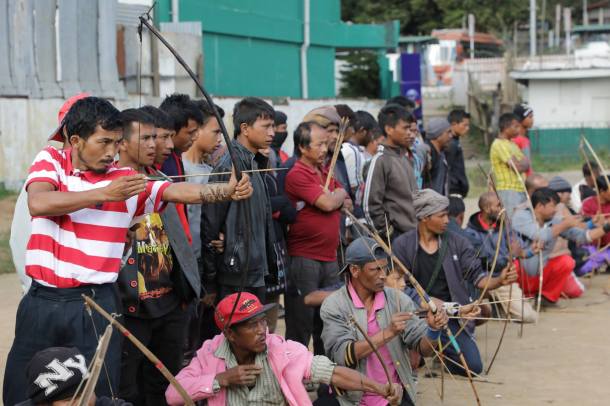


    In the world of murder, mystery, and atrocities she is coming to cast the spell of magic.

    But for him, she is coming to end this lifelong triviality. He knew then- wars, riots, drought, flood and other such trivial things can’t end their story. Come what their story would continue. Because without the Perseid Meteor and the Halley’s Comet, this world wouldn’t exist. Theirs is the world within a world. They are the continuity. No amount of separation can end their story.

    They are the eternal story-tellers and, this is the land of story-tellers and magicians. They are here for the story to begin and end. Begin and end. Begin and end. They are the story-makers. They are a story by itself.

    Hence, he had decided to complete his story. He decided to wait for her. Days, months, years passed by and he still waited for her. Meanwhile, he looked after their children. Took care of the stories. Delivering each of them to their respective owner. The story-teller delivered stories all through the night and during daytime he slept to create more stories. The evenings were reserved for testing those stories. Thus, he took the disguise of a story-teller and tested those stories on children.

    Every time, the children approved a story. The story-teller Santa Claus delivered it to an adult. In this way, every adult had a story approved by a child. The stories went on to live a happily ever after life while their parents roamed the planet in disguise of story-tellers.

    Meanwhile, as the land flourished its owner grew old. The story-teller was decaying in his own cocoon, trapped in the labyrinth of his magical kingdom. He knew the escape route but he was waiting for his knight in shining armour. He was well aware of his story. His old feeble forgetful mind still vividly remembered her.

    8 decades of separation hadn’t gathered rust on their relationship. Rather these 8 decades of separation weaved a beautiful life. A beautiful story. A story that he couldn’t tell the children. As it wasn’t his to tell. Someone else was writing it. It was her story.

    He was waiting for the story to end. He was waiting for it to be written.

    He was waiting to tell that story.

    His final departure.

    In between people have been wondering about him.

    “You have been telling stories for 60 years. Is there anything left to be said?” inquired his listeners.

    “Haven’t you told all the stories?” asked some.

    “How do you find so many stories?” asked others.

    “Aren’t you exhausted? When are you retiring?” inquired the new story-tellers.

    Seldom did they knew his secret. That he, himself was an unfinished story. A story with many sublets – Storylets. Small sublets of a story waiting to be weaved into a string by a writer, the Halley ’s Comet.

    For 8 decades the storylets are waiting to be stringed together.

    For 8 decades the Perseid meteorite was waiting for the Halley’s Comet.

    8 decades of a story to end.

    8 decades of story-telling, came to an end that night.

    That night, the story-teller told his final story.