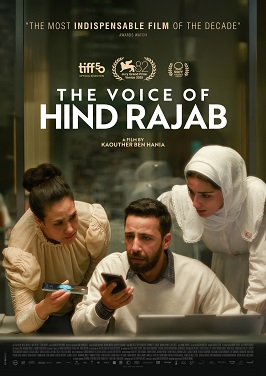
I sat watching this film just a couple of days after the Oscar night (which Palestinian citizen Motaz Malhees, the chief actor of the film, couldn’t attend because of a US visa denial) and amidst the ‘films shouldn’t be political’ controversy at Berlinale a month ago. I didn’t set out to see ‘The Voice of Hind Rajab’ through the cloak of this controversy, but the sensitive treatment of the material drew me into the debate, aided by my belief, which some can label as my bias.
To me, films or any form of work like painting, literature, or music can’t be devoid of the time it is set in. Whether it is set in the past, present, or future, it isn’t devoid of a surrounding, and that is its politics.
Politics isn’t just about regime change, violence, or power shifts, but about how we see the world. How I see the world is my own inherent nature, my bias; when other people’s views match partially or wholly with my view, it becomes political. So, my work, which reflects my or someone else’s way of seeing the world, is also political. In that sense, films like ‘Boong’ or ‘The Voice of Hind Rajab’ are also political, though they might seem like children’s films telling simple tales of survival and identity – the first was the identity crisis of a Manipuri boy and her mother, and the second was about the struggle for survival of the Palestinians shown through the tragedy of a 6-year-old trapped in a car filled with the corpses of her family. This rescue operation film in a war zone raises the question of identity, though it is not apparent in the film. Because without the context of the Palestinians’ identity erasure at the hands of the Israelis, medical aid would have reached her. Keeping that in mind, let’s get into the film.
Whose voice is it?
What a gut-wrenching tragedy ‘The Voice of Hind Rajab’ is. The filmmakers have done a fine job mixing documentary parts (with actual voice notes) into a feature film of a real incident of a family in Gaza trapped in a car being shot by the Israeli Army, shown through the voice of 6-year-old Hind Rajab, who was talking to a helpline for an entire day, asking to be rescued.
The real footage of the mother’s interview at the end showed that Hind Rajab only wanted the war to end. To go and play on the sand of the Gaza sea beach again.
Subtly, the film also depicts the problems faced by aid workers and healthcare workers and how the political situation has reached such a dire state that to get an ambulance from a place at a distance of 8 mins, you need hours of clearance – from the Red Cross to the Israeli Army to the Ambassadors to the Palestinian Health Department. From the same army that kills you, you have to get permission for safe passage, and then they will kill you when you just reach them with aid.
Shown through a child’s voice call to a rescue centre, it is a deeply political film with a humanitarian outlook. This film shows why films need to be political. And that’s precisely why the director refused the award at Berlinale and said she will return to take it when the genocide stops in Gaza. I understand his defiance more now. Initially, I loved her idea of opposing the system from within the system instead of Arundhati Roy’s boycott, but watching the film made her on-stage refusal at Berlinale make more sense. Because sometimes the atrocities are so inhuman that you have to be present there and say the truth firmly.
That visibility is your only weapon in times of systemic erasure. The film doesn’t show any bloodshed. There is no violence in it, unlike what you see in the news of the Hamada family getting killed by 335 bullets fired by the IDF at their car. What it has is silences. Those silences and gaps show the angst and dilemmas more than the dialogues.
What makes a film ‘political’?
So, what do you call a film like this, which doesn’t name the regime or name the politics of the time, but it is very apparent in their surroundings? Apart from Gaza, you will not hear the words ‘Israel’, ‘Palestine’ or even ‘Israeli Defence Forces’ in the film. The IDF is just called the Army, but you don’t know which country’s army it is. The countries aren’t named, but you know from the place names like Gaza and the West Bank that we are dealing with the Israel-Palestine conflict.
The characters never utter the controversial words that would categorize the film as “political.” But isn’t it political, as it reflects the brutal reality of the time? Aren’t you aware of it, even if it is not compelling you to take a pro- or anti-war stance? Aren’t you thinking that every norm and protocol has to be broken to stop this injustice from happening? To rescue the 6-year-old? That’s what films true to their times do. That’s why they are political.
One particular thing I like about these kinds of Middle Eastern films is their troughs of emotions, which show a range, not just a typical one type of emotion of angst, rage or grief. In a typical Indian film, the men and women working at the helpline would have got agitated and launched their own rescue mission. There would be too much one-dimensional emotion going on.
However, here, Rana, the rescue centre worker who talks with a 6-year-old trapped with the corpses of her family, shows a range of emotions. When they initially lose connection with Hind Rajab and think she is dead, she remembers the good rescue work she did before that. How she helped a 10-year-old deliver a baby of her elder sister through 5 hours of talking. That might be fictional, but the hope in her when the baby was delivered was priceless. She was so happy that day that she went home and did her full makeup in celebration.
At that very moment of this recollection, they try to call Hind Rajab again and find her still alive, but the tanks are getting close to her.
The most hopeful thing in the film is Rana telling the dying 6-year-old, “You say it is getting dark. But there is still some light left. We have time.”
But then again the time she had was butchered by the authorities by dangling the rescue bait.
That’s what is happening. The citizens of one country have time even after being attacked, but another country is using that time as bait to kill their time. That’s how political it is.
 Agantuk's Desk - Explore, Implore, Reverberate
Leave a comment