“The hand that rocks the cradle rules the world,” wrote poet William Ross Wallace in praise of women, especially mothers who remain confined to the boundaries of home. However, in real life, the situation is far from the fiction, especially for homemakers in rural areas of India, as 51-year-old Dipalika Banerjee Joshi and her compatriots Swarnali Chattopadhyay and Jayanta Sen found out in the sinking Sunderban.
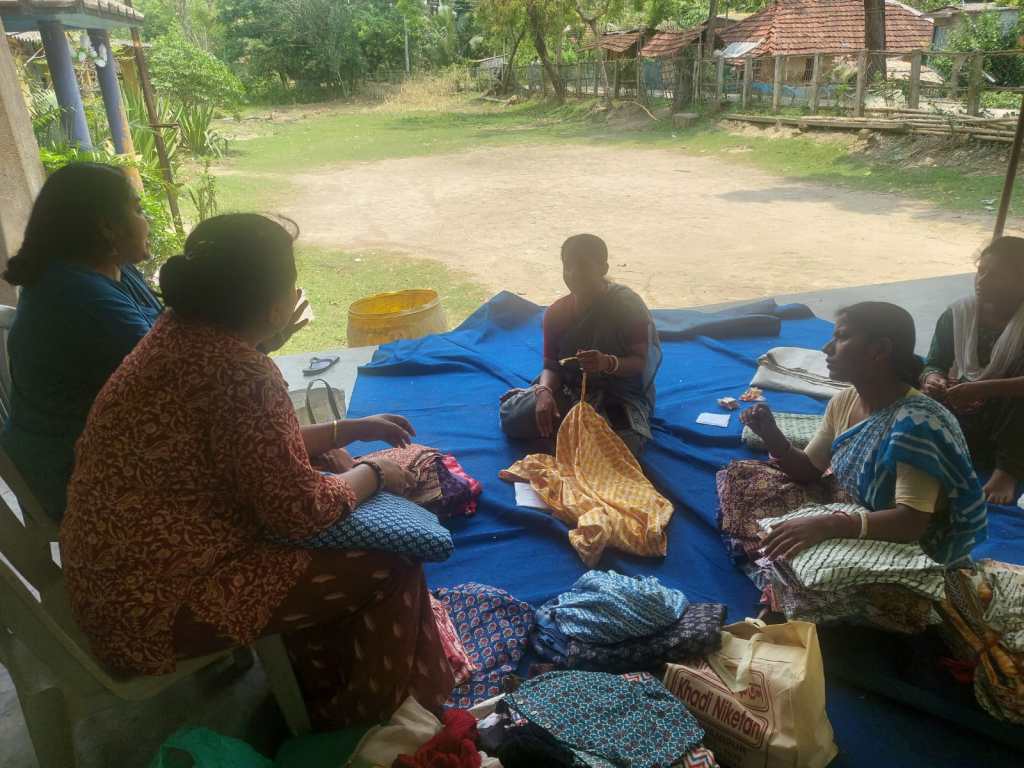
An English teacher by profession, Dipalika and her two friends of the same profession started a women empowerment unit, ‘Selaighar,’ meaning “Sewing House,” with 11 women learning to make clothing like Kanthas, Bengali-style quilts in the Piyali region of Sunderaban.
“As an English teacher, whenever I taught literature to my students, I naturally spoke of values and the larger role we play in society. But this value-based education took on deeper meaning when I began practising what I preached,” says Dipalika
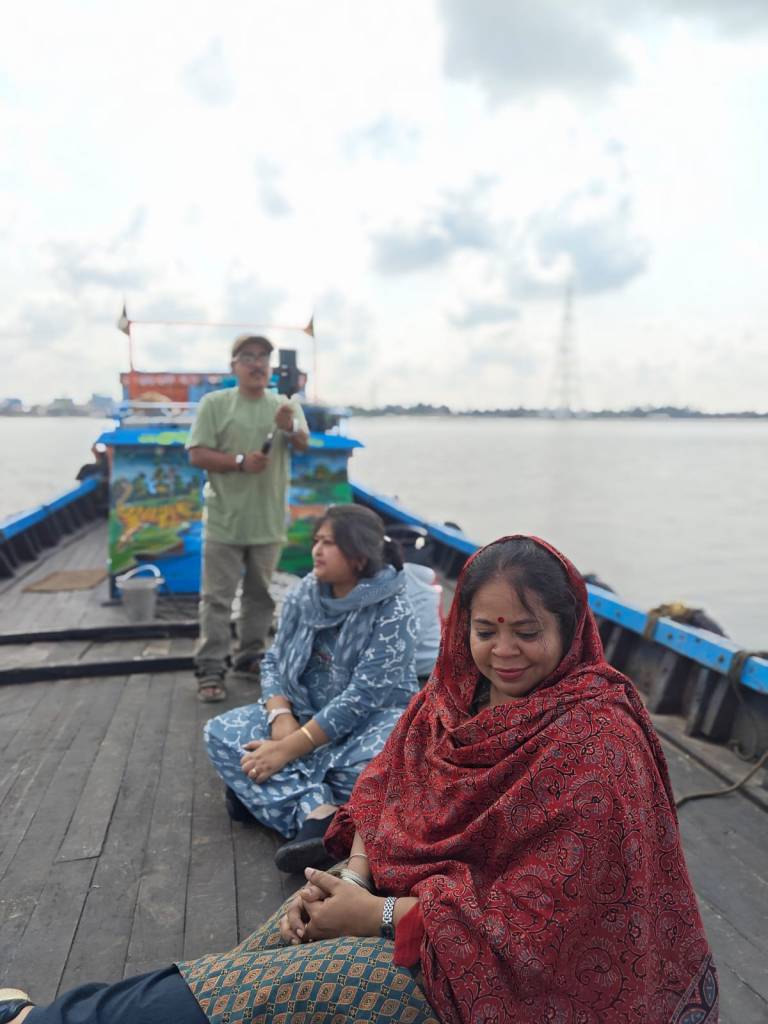
Dipalika and her friends on the way to Selaighar
The cyclone of realisation
The idea came out of her firsthand experience in relief work in the Cyclone Amphan-hit region in 2020. Initially, out on a citizen flood relief initiative from their heritage awareness group on Facebook called ‘Purono Kolkatar Golpo,’ Dipalika and her geology educator friends gradually realised the extent of the problem.
Providing essential materials and supplies wasn’t enough for these marginalised people, especially for women who were homemakers and didn’t know how to financially help their out-of-work husbands.
“Saline water had flooded the fields, rendering them uncultivable for the next 3-4years. We saw what lay ahead: most men would be forced to leave as migratory workers across India, while women—who were educated —would stay back to care for children, elders, the fields, and the poultry,” Dipalika explains.
This resulted in quick thinking on her part and her friends, and they set aside some money from the cyclone relief fund they had gathered from their ‘Purono Kolkatar Golpo’ group on Facebook. With that money, they started the Selaighar project in 2020, aiming to provide at least Rs 1000 monthly income to rural women, which in 5 years has spread out to 5 units across localities like Sagar Island and Ghoramara, employing about 97 people.
Nurturing the in-built skills of marginalised women
It’s not just natural calamities and the loss of jobs that drove Dipalika and her friends to start the Selaighar initiative. They understood the nurturing ethos of rural women who, though untrained, were already quite skilled in natural things like sewing and mending clothes.
“In Bengali households, from our childhood, we have seen one constant thing—mending and sewing. We have watched our mothers and grandmothers join borders of old cotton saris to make light quilts or craft kantha quilts from worn-out saris with beautiful embroidery,” Dipalika said.
The educator further illustrated what prompted them to start a clothing-making venture with these homemakers from Sunderaban instead of other things.
“We’ve seen them mend clothes skilfully. In some households, women even stitched children’s clothes or blouses—things that concerned them and where thrift mattered,” revealed Dipalika.
So the skill was already there. What these underprivileged women needed to turn it into a livelihood was some basic training and certification. At first, the Selaighar women started making basic things like masks and cotton bags and gradually moved onto skirts, shirts, dresses, table mats, and Bengali-style quilts.

This was during the COVID-19 pandemic, and these marginalised women helped in fighting the virus by delivering 10,000 masks for the Gangasagar Mela, resulting in them getting more work from the Sundarban Development Authority.
Wading through adversities
However, not all triumphs are long-standing, and soon Dipalika and her schoolteacher friends faced the challenges of women’s empowerment. Their first centre in Piyali had to be shut down, as it was too close to Calcutta. So, most women didn’t return to making clothes and went to the city to work as house-helps once the covid lockdown ended.
Dipalika says, “Failures like this made them realise that the need for this kind of women empowerment initiative is greater in remote areas like Sagar Island and Ghoramara Island, which are extremely remote and vulnerable to cyclones.”

The Selaighar women working
Hence, they ventured into more remote areas, setting up more units where there was a demand for them. Initially, they arranged for a 3-month training program with a paid tutor who taught 22 women in Piyali how to make kurtis, shirts, dresses, trousers, and quilts. But the women got interested in learning further, resulting in a 6-month training program done in association with the leading sewing machine manufacturer brand, Singer India.
After the training, the Selaighar women had to sit for an examination in a Singer India-approved course to get a certificate. Armed with this credential, they metamorphosed into a trained worker whose skills were recognised, making more work available for them.
Weaving sustainability and a dying tradition
The training not only provides some financial freedom and work for the homemakers but also provides an opportunity for Dipalika and her friends to keep traditional skills like Bengali-style quilts, or Kantha-making, alive.
“This wasn’t just about introducing a new skill—it was about reviving a traditional one many of them already carried in their hands and hearts: Kantha-making,” Dipalika said. Recently, the Selaighar women went through an 8-day Kantha embroidery training workshop conducted by national award-winning artisan Bina Dey.

Learning Kantha embroidery from Bina Dey
Speaking about their outlook on reviving old traditions and sustainable living, Dipalika explained how the Kantha tradition originated in Bengal in 1500 BCE, “when women repurposed worn textiles into quilts and other household items.”

“They layered old saris, dhotis, or lungis and stitched them together using threads pulled from old fabric, creating intricate patterns. Often, these kanthas became family heirlooms—stitched lovingly over the years by grandmothers, mothers, and daughters. Kantha is not just embroidery; it embodies thrift, sustainability, and artistry,” she added.
She and her friends not only enhance the skills of these marginalised women in Sunderaban but also help them maximise their real-life natural skills for the betterment of the habitat. This happened when 80 women from the Selaighar project were involved in conducting a pilot survey after some basic training. It was a joint project of Jadavpur University and IIEST Shibpur, which ended with the women planting 4150 mangrove saplings in 2021.
Delivering confidence to rural women
The fruits of her labour and that of the marginalised women finally culminated in delivering shirts, skirts, tunics, etc., to people in Calcutta and in cities like Bangalore and Delhi. Some even travel outside the country to the US and the UK. Sometimes, the women get to have fun as they make school uniforms, football jerseys, and bags for corporate events.
This is all possible because Dipalika and her team efficiently source reusable and eco-friendly materials like old saris from Calcutta and supply the end products to the customers. Capitalising on their initial strength as a community-centric heritage lovers group on Facebook, Selaighar also holds an exhibition twice a year where products made by these women are bought and sold.
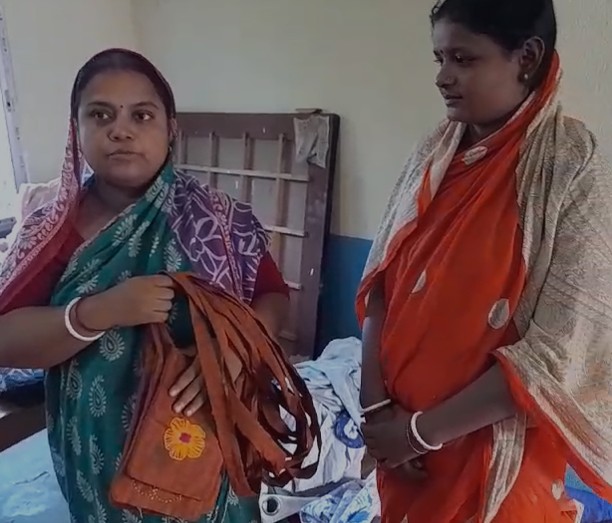
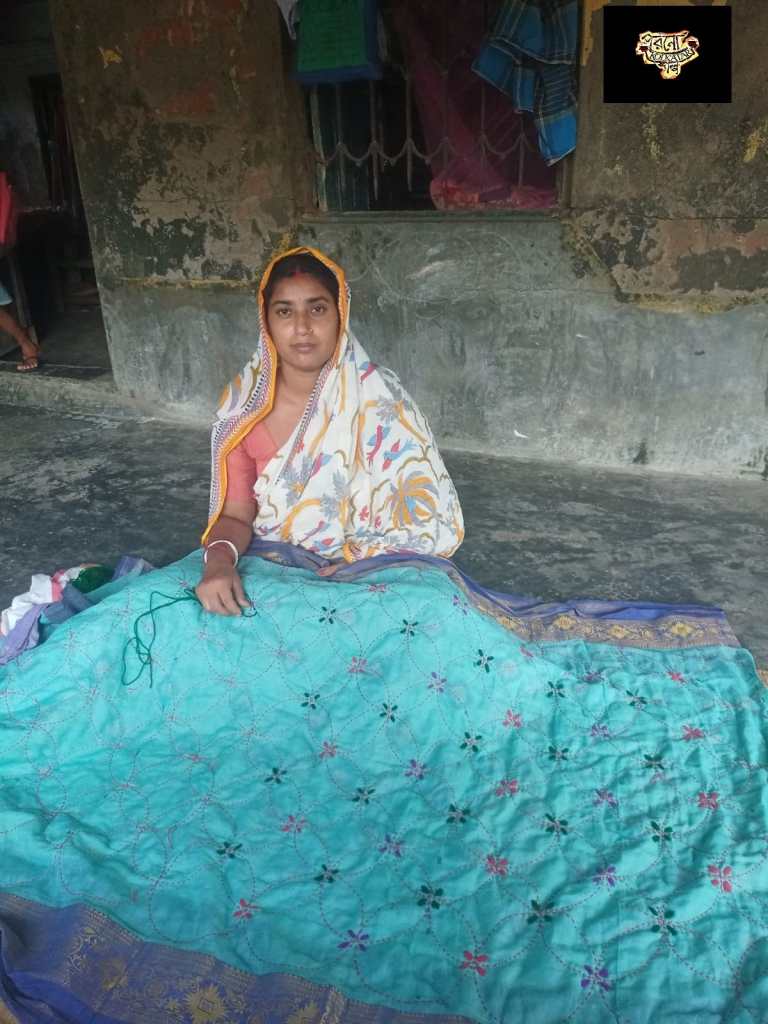
A kantha being made from recycled cotton sarees
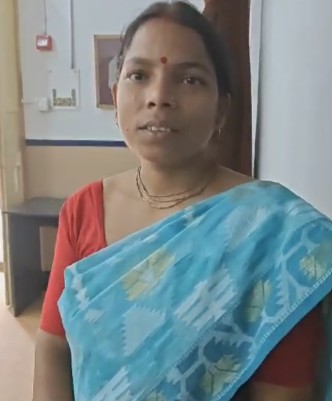
Many of these women also visit the exhibition to see how their work is being appreciated by the people in the city. A Selaighar woman named Monimala Bhuiya, a mother of one, revealed how this earning has given her freedom, making her have a say in her son’s upbringing.
“With this earning, I can pay for the school fees of my kid and even drawing and tabla lessons,” said Monimala.
Another Selaighar woman, Moushumi Das, said she feels good making the Bengali-style quilts and the various types of bags, including customised orders. “We have gained much from working here. Earlier, we used to spend our afternoons idly at home, but now we have some work,” she added.
For Dipalika and her friends, the path towards empowering rural homemakers in Sunderbans is laden with bottlenecks like dropouts due to women’s household duties, but it isn’t entirely impossible.
You can get in touch with her at +91 96326 67566 to purchase their products or to commission the Selaighar women for some custom-made work.
 Agantuk's Desk - Explore, Implore, Reverberate
Leave a comment